A New Expression of High Performance.
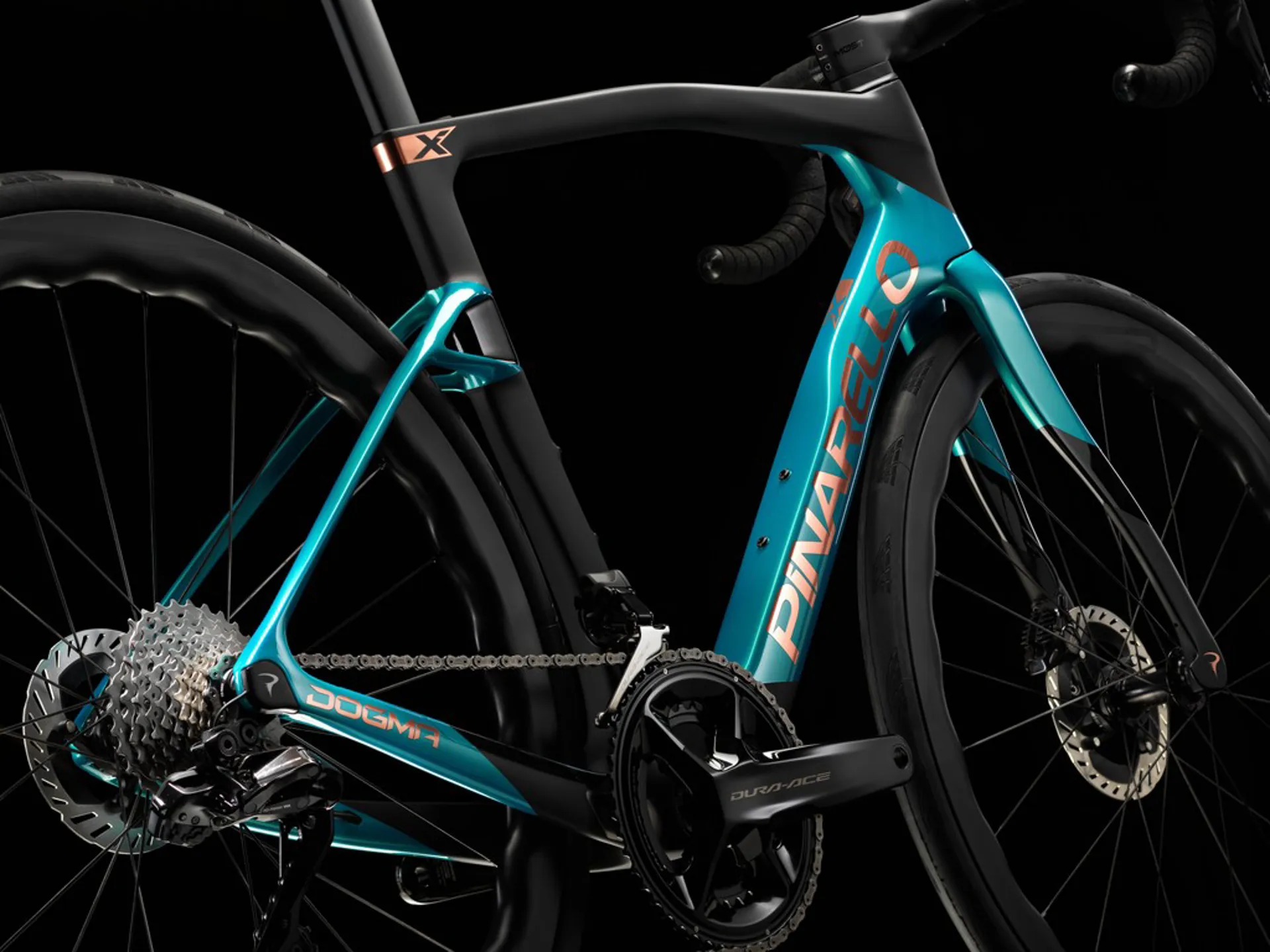
The first Dogma X made a precise argument: that Pinarello's engineering rigour, applied to an all-round geometry and a compliance-tuned rear triangle, could produce a frame that was genuinely fast, genuinely capable on any road, and unambiguously a Dogma. That argument was well made. The bike delivered on its brief, and nothing about the original's core identity needed correcting.
The new, Gen 2 Dogma X is not a correction. It is a comprehensive rebuild — the platform brought fully in line with the current state of Pinarello engineering across carbon, structure, and aerodynamics simultaneously. Three things change: the frame now runs M40X carbon, the same fibre Pinarello introduced on the MY25 Dogma F; the rear triangle has been reengineered as X-Stays 2.0, with a lower attachment geometry and a more precisely distributed four-point compliance system; and the front end has received a full aerodynamic overhaul, with a new elliptical headtube, differentiated bearings, hidden thru axle, and a tapered downtube that is simultaneously faster and stiffer. An all-round geometry that sacrifices nothing to performance.
M40X Carbon: The Same Foundation as the Dogma F
The most significant change in the new Dogma X is one that is invisible in photographs and measurable only in the data: the frame now runs TorayCa M40X carbon, the same fibre Pinarello introduced on the MY25 Dogma F. The outgoing Dogma X was built on T1100 1K Dream Carbon with Nanoalloy Technology — itself one of the most advanced production carbon fibres available, and the material that powered the race platform used by INEOS Grenadiers across the previous F generation. M40X goes further.
The designation M40X refers to the modulus classification of the carbon fibre: a high modulus specification that delivers superior rigidity per unit of weight compared to the T1100 benchmark. When Pinarello introduced M40X on the MY25 Dogma F, the result was a measurably lighter frame with increased lateral stiffness — a combination previously considered a compromise in carbon frame engineering. The new Dogma X inherits that same material advantage. In Pinarello's own words: the most advanced carbon fibre frame currently on the market.
The practical consequence is straightforward. The Dogma X and the Dogma F now share an identical material foundation. What separates the two frames is not the specification of the carbon itself, but what is done with it: the geometry, the rear triangle architecture, the tyre clearance, and the structural intent. The F is engineered for outright speed at the limit of smooth road performance. The X is engineered for uncompromising performance across every surface, for longer rides and for a broader audience — the bike Pinarello describe as one that keeps the rider fresher, sharper, and faster for longer. The gap between those briefs is now defined entirely by engineering decisions, not material hierarchy.
X-Stays 2.0: A More Intelligent Rear Triangle
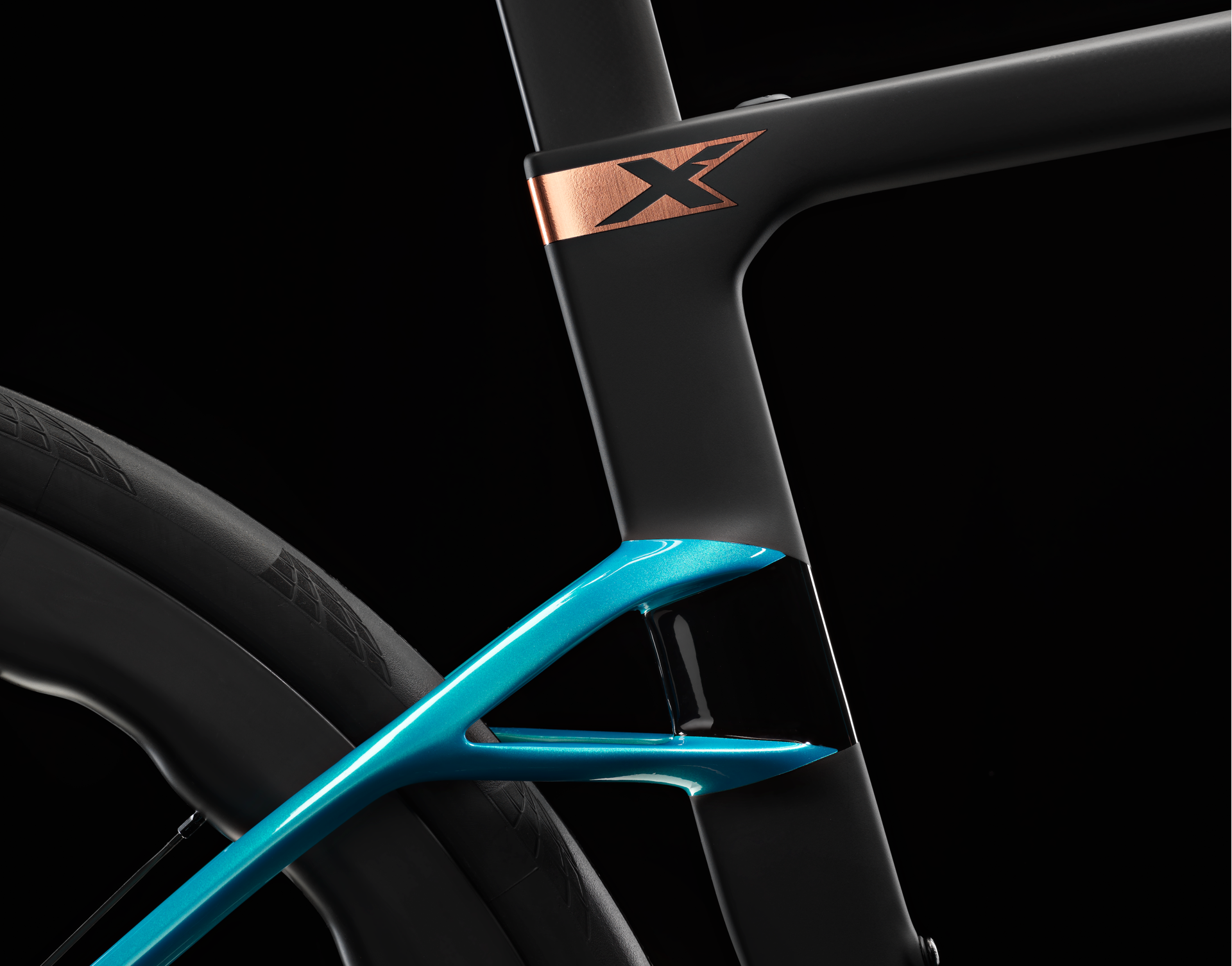
The rear triangle of the original Dogma X was already the defining structural argument for the bike's existence. X-Stays — the twin-element seatstay design in which two independent carbon spars diverge from the seat cluster, arc outward, and reconverge at the rear dropout — delivered measurably greater vertical compliance than the Dogma F with no detectable loss in lateral stiffness. The logic was sound. The execution was thorough. For the Dogma X, Pinarello has refined both.
X-Stays 2.0 introduces a lower attachment point at the seat cluster, a change in geometry that has direct consequences for how the system handles road energy. The four connection points — two at the seat tube, two at the dropout — are now positioned and angled to distribute vibrations more evenly through the structure before any of that energy reaches the saddle. The geometry of the diverging arms has been recalculated accordingly. The lower linkage point specifically, minimises rebound: the controlled return of a deflected stay is shorter and better damped, so the ride quality on consecutive rough inputs — washboard gravel, repeated road joints, sustained broken tarmac — is more composed and less fatiguing than the original design. The compliance is still present; it is now better managed.
Between the chainstays, the cross-braced bridge insert that controls lower triangle flex under pedalling loads is carried over unchanged. Power transfer through the bottom bracket remains direct and present. X-Stays 2.0 retains the fundamental character of the system — simultaneous compliance and stiffness — while improving its behaviour at its most demanding operating point: sustained high-frequency inputs over broken surfaces at race effort.
Aerodynamics: Front End Rebuilt
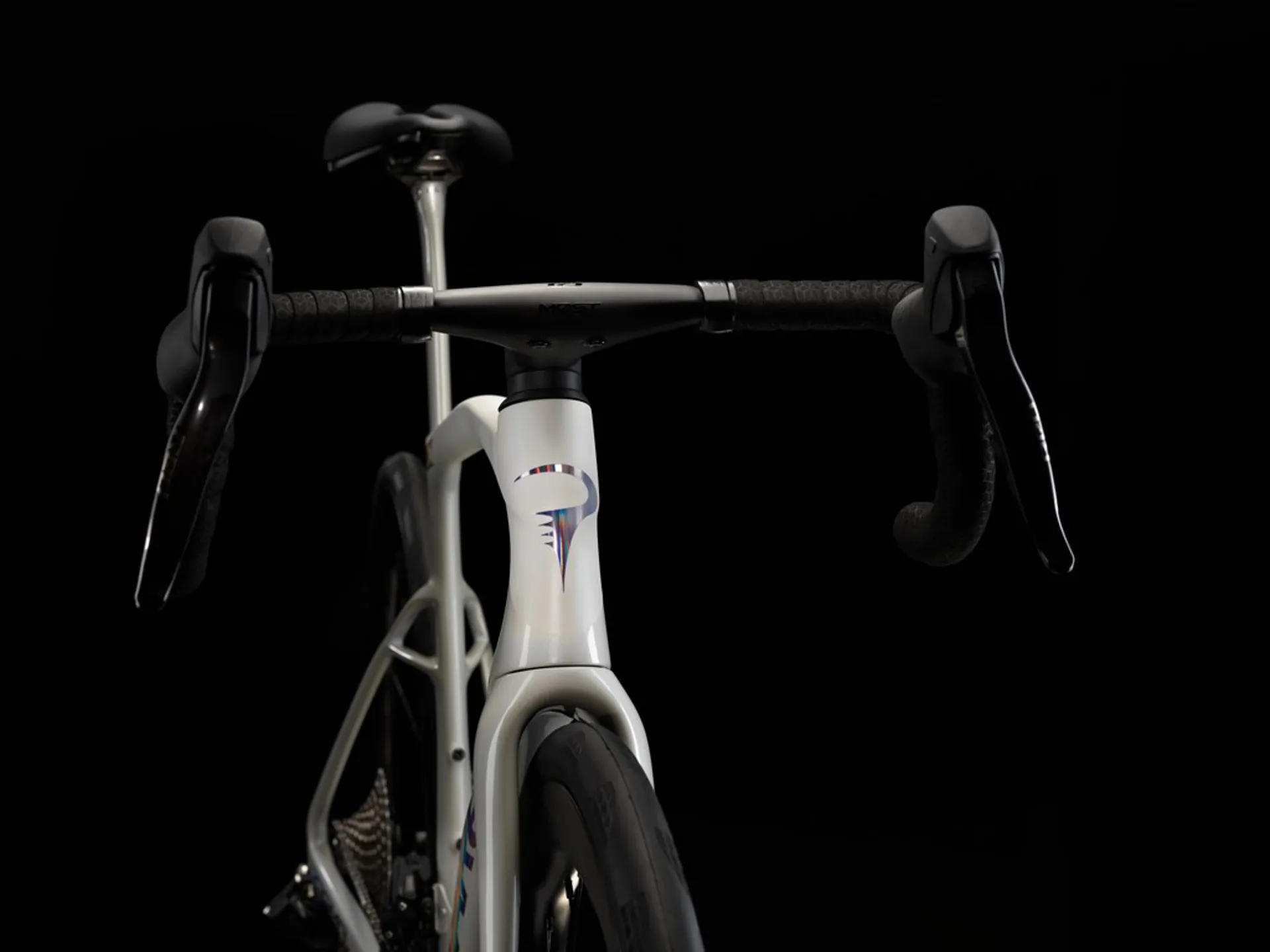
The original Dogma X was not primarily an aerodynamic exercise — a considered choice for a frame whose brief prioritised structural compliance and geometry above CdA. The 2027 frame addresses that balance. Three independent aerodynamic improvements appear on the front end, each the result of a redesign rather than a refinement.
The headtube has been redesigned around an elliptical cross-section — what Pinarello designates eTiCR — that reduces frontal width at the leading edge while maintaining full structural integrity. The elliptical form demanded a completely new headset, with differentiated bearing races: wider at the bottom to handle the steering forces of a longer, more stable front end, narrower at the top where the geometry allows a slimmer cross-section. The aerodynamic headtube bow profile, first introduced on the Dogma F8 in 2014 and evolved across every generation since, has been developed for the X into its most streamlined iteration yet — reduced in volume, reduced in width, and producing measurably lower frontal area than its predecessor.

Like the F, the thru axle is now concealed: the thread is hidden inside the fork leg, removing one of the last external protrusions on the front end and producing a fork crown that is visually cleaner and fractionally more aerodynamic. The downtube has been completely recast. Narrower in section and tapered along its length, it reduces drag in the section of the frame most exposed to crosswind loading while simultaneously increasing the tube's contribution to lateral frame stiffness. That the same design change improves both aerodynamics and stiffness simultaneously is not an accident — it reflects the same engineering logic Pinarello applied to the MY25 Dogma F's downtube, now carried into the X platform.
Outgoing Dogma X vs MY27 Dogma X: What Changed
| Outgoing Dogma X (2023) | 2027 Dogma X |
|---|
| Frame carbon | TorayCa T1100 1K Dream Carbon + Nanoalloy | TorayCa M40X — same as MY25 Dogma F |
| Rear triangle | X-Stays (original four-point design) | X-Stays 2.0 — lower attachment point, refined geometry, reduced rebound |
| Headtube | Standard aerodynamic headtube bow profile | ETICR elliptical — reduced width, new differentiated headset bearings |
| Downtube | Standard section | New narrower tapered aero section — improved aerodynamics and lateral stiffness |
| Front thru axle | External thread | Hidden thread — cleaner, more aerodynamic |
| Geometry | All-round — 11 sizes, UCI approved | Unchanged |
| Tyre clearance | 700c × 35mm | Unchanged |
| Cable routing | TiCR fully internal | Unchanged |
| Bottom bracket | Italian thread | Unchanged |
| Seatclamp | 3D-printed titanium | Unchanged |
| Dropout compatibility | Shimano standard | Pinarello Design Dropout — SRAM UDH and Shimano compatible |
Riders on the outgoing Dogma X are riding a frame whose structural argument remains the standard the new X was built to extend. The 2027 Dogma X inherits that argument and advances it: same intent, more capable execution at every technical touchpoint.
Geometry: Dogma X vs Dogma F
Pinarello describe the Dogma X's geometry as all-round — designed around the rider, stable over long distances, yet sharp and precise in every corner, sacrificing nothing to performance across eleven real frame sizes. It sits in a distinct position relative to the Dogma F: approximately 17–19mm more stack across the mid-range, with a modestly shorter reach of 4–6mm, a head tube angle 0.7–1° slacker, chainstays 13–15mm longer, and a bottom bracket sitting 5mm deeper. Both frames share a 47mm fork offset.
Those numbers compound in the way that geometry numbers always do. The Dogma X carries a lower centre of gravity, a longer wheelbase, and a front end that is more self-stabilising at lower speeds and on degraded surfaces — without sacrificing the precision and immediacy at race pace that a Dogma must deliver. It is not a relaxed bike. It is a bike calibrated for a different definition of performance: one that accounts for road quality, distance, and the accumulated cost of hours at high effort.
Eleven sizes from 43cm to 62cm, represent the broadest fit range of any performance road frame in the current market. A rider who would require excessive spacer stacks and a shortened stem on a Dogma F — both of which degrade handling precision — can find a correctly proportioned Dogma X and ride it with standard configuration. The performance argument for that is not subtle: correct geometry handles better than compensated geometry, at all speeds.
| Geometry (54cm) | Dogma X (MY27) | Dogma F (MY25) |
|---|
| Head tube angle | 72.0° | 72.8° |
| Stack | 568mm | 551mm (+17mm on X) |
| Reach | 381mm | 385mm (4mm shorter on X) |
| BB drop | 77mm | 72mm (X sits 5mm lower) |
| Chainstay | 422mm | 408mm (14mm longer on X) |
| Fork offset | 47mm | 47mm (identical) |
| Tyre clearance | 700c × 35mm | 700c × 32mm |
The M40X carbon shared between these two frames means the material distinction that once separated them no longer exists. Both platforms begin from the same fibre specification. The geometry detail above is the full answer to what separates them — and those numbers are, by design, the right answer for different riders with different roads and different definitions of what a perfect day on the bike looks like.
On the Road
The Dogma X rides like a race bike that has stopped penalising the rider, for the road not being perfect. Front-end response is direct and immediate — the geometry holds a line in fast corners without requiring active management, descents are assured, and pace-lining in a group demands no recalibration from anyone arriving from the Dogma F or any other serious performance platform. The X does not ride like a bike that has been softened. It rides like a Dogma with a broader operating range.

The compliance character of X-Stays 2.0 works from the rear triangle, and it works in ways that accumulate rather than announce themselves. Road buzz across sustained rough surfaces is attenuated before it reaches the saddle or the hands. Sharp discrete impacts are absorbed in the rear triangle rather than transmitted up the seat tube. What remains at the contact points is the information the road is actually sending — terrain feedback rather than structural noise — which is a meaningfully different experience over three and four hour efforts at high pace. Sustained threshold output on rough climbs is where X-Stays 2.0 makes its most legible argument: the rider stays in the power position through surface irregularities that would force micro-adjustments on a more rigid rear end, and that continuity of effort compounds across the length of a climb.
The M40X upgrade sharpens the frame's response under acceleration and in corners. Lateral stiffness — the property that determines how cleanly pedalling torque translates into forward motion — is at least as high as the outgoing Dogma X, and the new downtube's geometry contributes a front-end solidity that is perceptibly different from the previous generation. The bike is planted. It does not wander. This is not comfort as a concession. It is, as Pinarello describe it, a more intelligent and sophisticated expression of performance.
Dogma X Range
At launch in July 2026, the new Dogma X is available in 3 colorways as complete bikes only: Aqua Veil, Etna Lucente and Jade Eclipse, with all 4 colourways (Moonlight Frost in addition) available as framesets from September.
For complete builds, the configuration runs either Shimano Dura-Ace Di2 with Princeton CarbonWorks GRIT Evo 4540 wheels or Sram RED AXS with those same hoops both with the Most Talon Ultra Fast cockpit.
Frameset Specification
| Specification | Detail |
|---|
| Frame | TorayCa M40X Carbon — the most advanced carbon fibre layup in current production |
| Rear Triangle | X-Stays 2.0 — lower attachment point, four-point double-arm design, cross-braced chainstay bridge insert |
| Headtube | ETICR elliptical — reduced frontal width, differentiated headset bearings (wider at base, narrower at top) |
| Downtube | New narrower tapered aero profile — improved aerodynamics and lateral stiffness |
| Fork | X Onda with ForkFlap™ — hidden front thru axle thread |
| Cable Routing | TiCR — fully internal throughout |
| Bottom Bracket | Italian thread |
| Seatclamp | 3D-printed titanium, bonded at manufacture |
| Dropout | Pinarello Design Dropout — SRAM UDH and Shimano compatible |
| Tyre Clearance | 700c × 35mm — tubeless ready |
| Disc Brakes | Flat mount, 160mm maximum rotor |
| Sizes | 43–62cm, 11 sizes |
| UCI Approved | Yes |
| Kit Contents | Frame, fork, headset, seatpost |