3T Ultra² Italia
A technical overview of 3T's second-generation endurance gravel platform
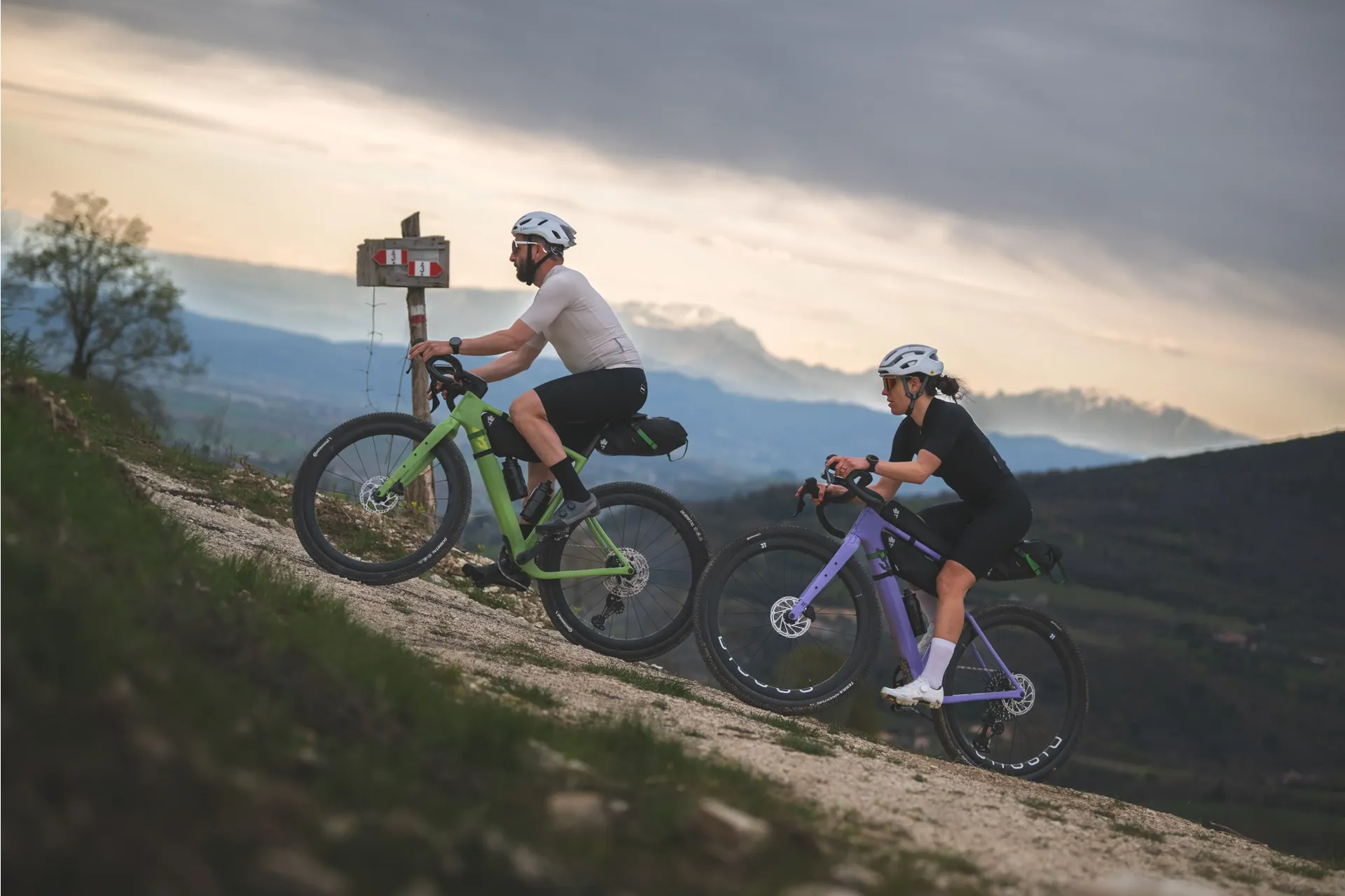
3T's gravel triumvirate - RaceMax, Extrema and Ultra - has matured into a clearly differentiated range, and the new Ultra² Italia is the bike that finally pulls the comfort/endurance side of that family decisively away from the race-bike DNA it used to share. The headline numbers are the easy story: a 700c tyre clearance of up to 57mm, native compatibility with the DT Swiss F 132 ONE 40mm short-travel suspension fork, an internal downtube glovebox, and a frame that is now built end-to-end at 3T's headquarters in Bergamo using their proprietary construction process : Fusion Carbon.
The harder story - and the more interesting one - is what those numbers do to the bike's position in the range, and how they translate into rider benefit on real terrain.
What is genuinely new for the Ultra²
Fusion Carbon: Italian provenance at a non-Italian price
3T has built its halo Italia frames - RaceMax² Italia, Extrema Italia, Strada Italia - with a proprietary process the company calls
Jazz Carbon: dry-filament winding combined with resin transfer moulding (RTM). It is excellent. And expensive.
The response is
Fusion Carbon. The Ultra uses the same dry-filament winding and RTM processes for the load-bearing structure, but layers in selected elements of conventional carbon construction for the more forgiving sections of the frame. With the same equipment and workforce, 3T claims it can produce three to four times the number of frames per shift vs Jazz.
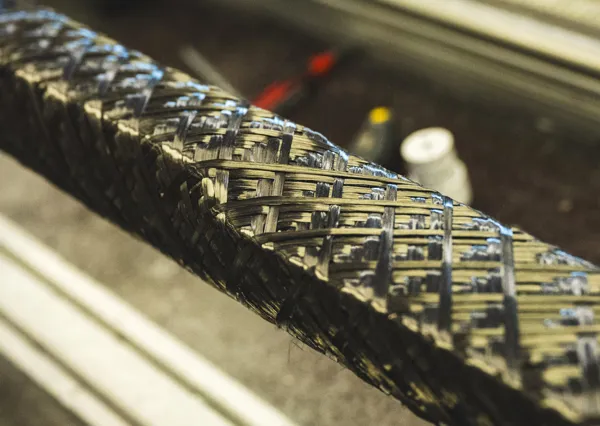
The result for the buyer is a frame made 100% in Italy that costs roughly a third less than 3T's Jazz-built Italia bikes. The frameset pricing starts at £3539 which includes the Ultra² frame, the matching Fango Ultra² carbon fork, headset, the More² stem, the Superghiaia Integrale LTD bar with tape, and a zero-offset 3T 27.2 mm carbon seatpost. For those looking for ultimate comfort and control, the Frameset is also available at £4557 with DT Swiss 40mm Travel Suspension Fork. Complete builds run from £4426 (mechanical Shimano GRX 1×12) up to £7213 (GRX Di2 1×12 or SRAM Rival/GX Eagle Transmission AXS, both with Discus 45|40 wheels).
3T quotes 1,199g for the size-M frame and 450g for the matching Fango Ultra² fork (both unpainted, ±5%). That is roughly 280g heavier as a frameset than the Jazz-built RaceMax² Italia (claimed 990g frame, 380g fork) - about 20% - but the Ultra² is asking the carbon to do far more work: integrated downtube storage, suspension correction, internal dynamo routing and clearance for 700×57 rubber.
The benefits to you as a rider of the new Fusion Carbon are: a properly Italian-built carbon endurance frame at roughly 25% more than the original Asian-built Ultra, rather than the much higher premium Italia bikes have historically asked. The weight penalty versus the Jazz-built bikes is real but proportionate to the extra capability, and the structural performance and continuous-fibre layup the brand is known for are preserved to deliver a far livlier and more durable and enjoyable ride than previous pre-preg carbon models.
Tyre clearance: 57mm in 700c, properly!
The official tech sheet quotes
700c up to 57mm WAM (369.5 mm RAM) with the rigid Fango Ultra² fork in 1× configuration, dropping to
700×50 with the DT Swiss F 132 ONE 56 mm-offset suspension fork. With a 2× drivetrain, clearance is gated by the front derailleur: GRX 2×12 mechanical retains the full 57mm headroom ("no limitations" in 3T's wording), but GRX 2×12 Di2 and Campagnolo 2×13 are limited to 54mm WAM. Minimum recommended tyre is 47mm RAM. On 650b wheels, the frame remains in the original Ultra's 55–61 mm sweet spot - still the aerodynamically optimised setup for chunky tyres at gravel-race speeds - but 3T expect the Ultra² to be most widely used with 700c.
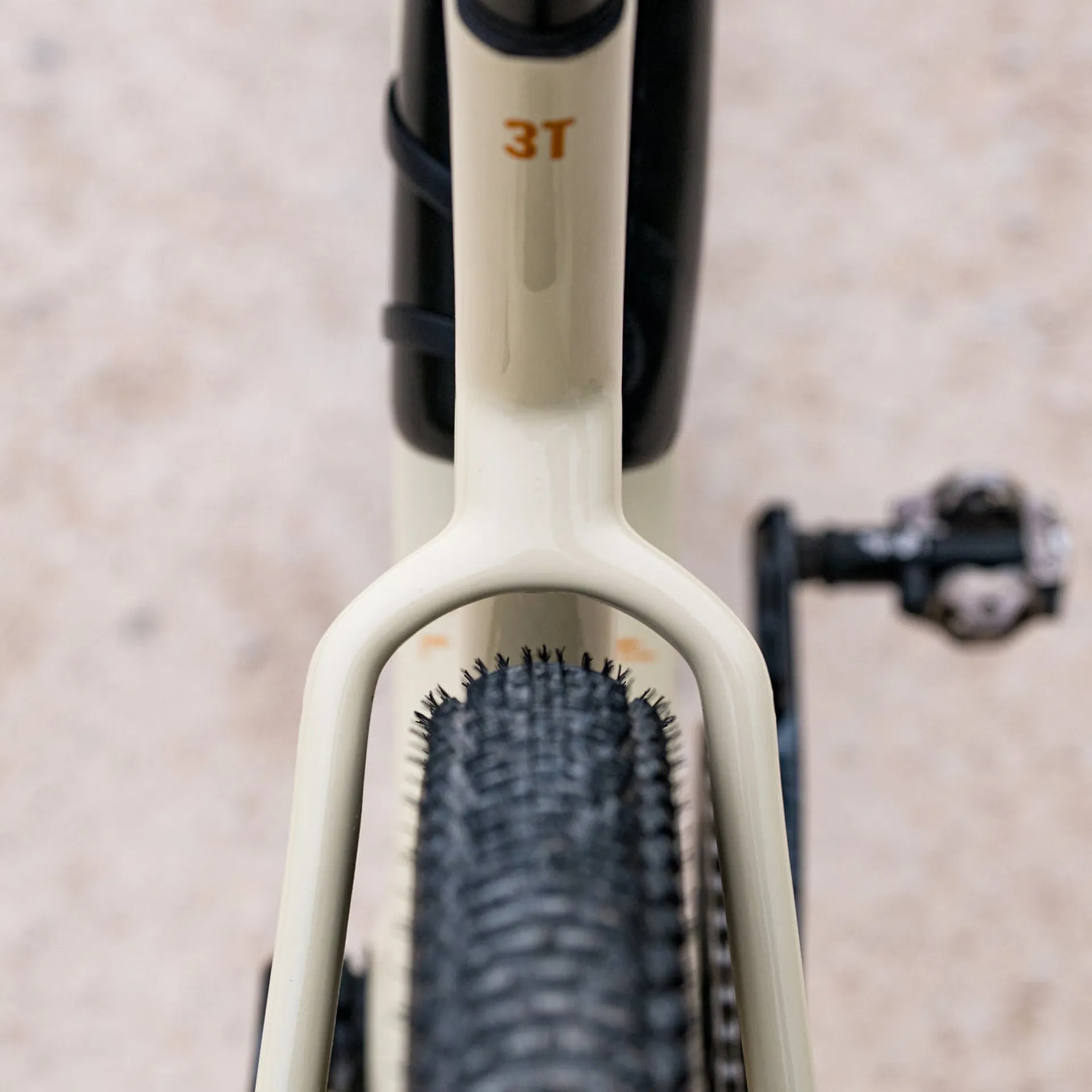
Versus the original Ultra's 46mm 700c ceiling, this clearance is a step-change. It opens up genuine 29×2.2" rubber, the kind of tyre that was, until recently, MTB territory. Combined with the suspension-corrected geometry, it allows riders to tune the bike's personality very widely with a wheel/tyre swap: 700×42 fast-rolling tan-walls for an audax day, 700×57 file-tread for a multi-day mixed-surface tour, or 650b×60 mud-eaters for British winter.
Key benefits of the ever widening tyre clearance on gravel rigs is the versatility. One frame, three plausible builds. The Ultra also offers less compromise on chunky terrain without giving up 700c rolling speed when conditions allow. The drivetrain choice does carry a real clearance cost in 2×, which is worth noting. Arguably the SRAM equipped models will be the key sellers with Sram's excellent 1x13 AXS components delivering a suitable range to cover most terrain.
Suspension correction: gravel suspension as a first-class citizen
This is arguably the most consequential geometric decision on the bike. The Fango Ultra² fork has an
axle-to-crown of 430mm - roughly 43 mm taller than the Extrema's rigid fork - which means the frame is designed around a short-travel suspension fork. The official upgrade and 3T's named recommendation is the
40mm-travel DT Swiss F 132 ONE in 56mm offset. Crucially, the geometry remains correct - head angle, BB drop, trail - whether the rider chooses the rigid Fango Ultra² or the F 132 ONE.
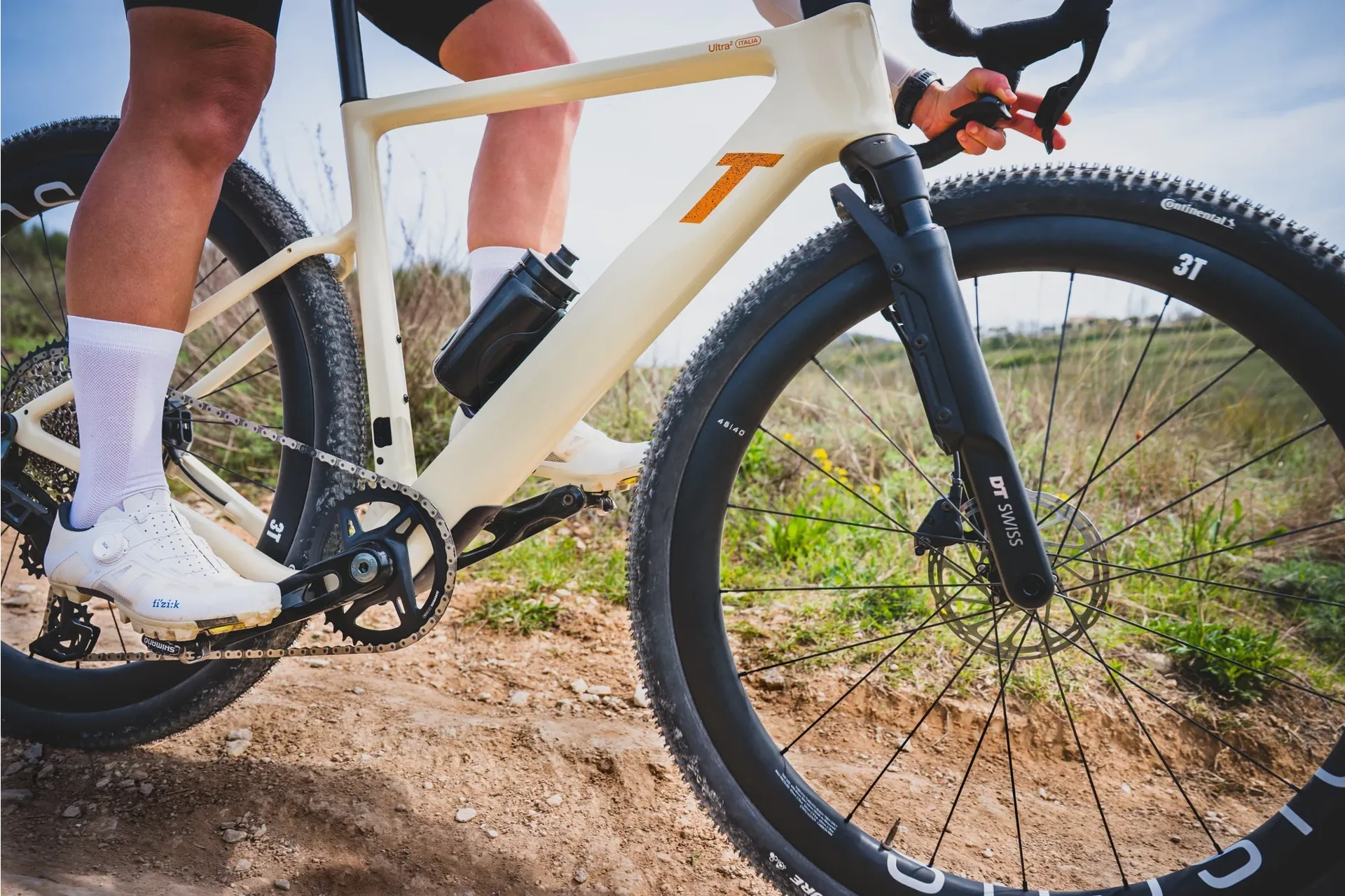
This is different from the way most gravel brands have approached suspension. A typical rigid gravel frame fitted with a sus fork ends up with a slightly slacker head angle and higher front, which usually compromises steering. By designing the Ultra² around the longer fork, 3T preserves the intended handling under both setups; if you remove the suspension, you simply fit the matched longer rigid fork.
What this means in real terms is genuine traction and comfort gains on long, rough stages without making the bike feel - for want of a better word - weird. Unbound or Trans Iberian on the F 132 ONE, then a winter swap to the rigid Fango for road-leaning training, with no geometric compromise either way.
Geometry tuned for hours.
The Ultra² sits at 580mm of stack in size M - exactly +10mm versus the Extrema Italia, and the most relaxed front end of any current 3T gravel bike. Reach is 368mm in Medium, slightly shorter than the Extrema's medium reach, which compounds the more upright cockpit. Rear centre is held at a flat 437mm across all four sizes (S–XL), essentially identical to the Extrema's 436 mm; it is the longer fork (and therefore longer front centre) that does most of the work moving the rider's weight rearward and adding straight-line composure under bag load, not the chainstay. This serves to preserve response to power input and rear end traction.
Ultimately the geometry reduces neck and shoulder fatigue across 12-hour-plus days. The hand position lands closer to where most ultra-distance riders end up retrofitting their race bikes anyway - spacers, shorter stem, riser bar - except here it is the design intent rather than a workaround and is baked in. The maximum 35mm headset spacer stack (3T notes 20mm or less is ideal for handling) gives further fit headroom for upright bars and high-volume bar bags.
Size-specific head angle: handling that scales with the rider
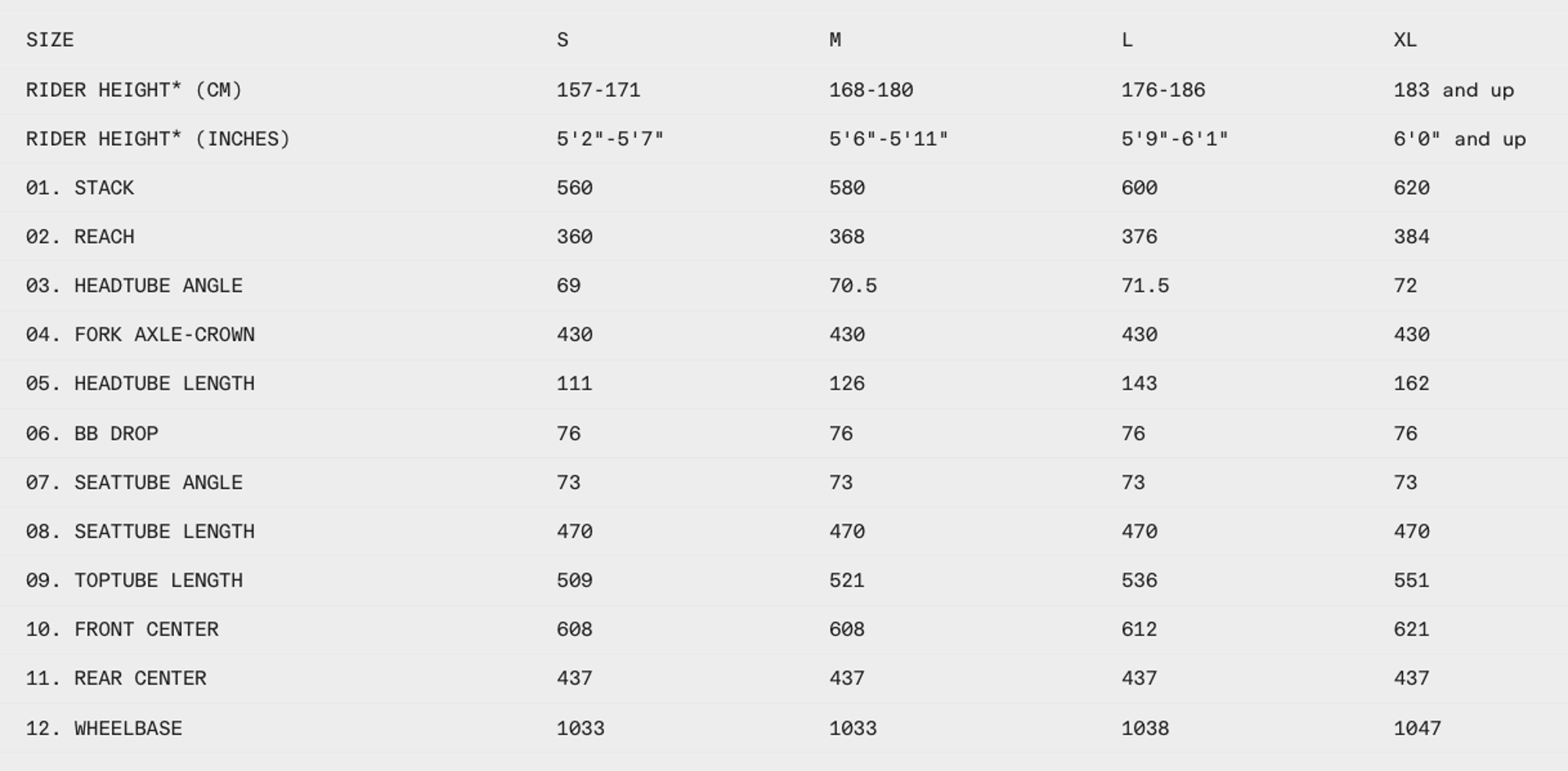
One subtlety in the geometry chart that is easy to miss is that the head angle changes by size. The Ultra² runs 69° on the S, 70.5° on M, 71.5° on L and 72° on XL, with reach growing from 360 mm to 384mm and stack from 560mm to 620mm across the same range. Front-centre and wheelbase grow accordingly (1,033mm on S/M, 1,038mm on L, 1,047mm on XL).
The result is that smaller riders get more relaxed steering and more wheel-flop tolerance under load - a genuine help on technical descents at lower mass and momentum - while taller riders, whose longer wheelbase would otherwise feel sluggish, get a sharper front end to match. This is a deliberate handling-equalisation strategy, not an artefact, and it is the kind of detail that distinguishes a frame designed by a small geometry-led brand from one designed around a single-size prototype.
Storage, mounts and integration
The downtube now houses an internal storage compartment with a Fidlock magnetic closure and a dedicated Miss Grape neoprene insert that keeps tools and CO
2 silent. The fork carries triple cargo mounts and the fork legs are routed for a dynamo cable internally; cable routing through the front end is tidier than the original Ultra's and there are bag, rack and mudguard mounts spread across the frame. None of these features is individually new to gravel in 2026, but the combination on a single frame at this price point is refreshing (and similar to our original Bōken Ti Gravel frame).
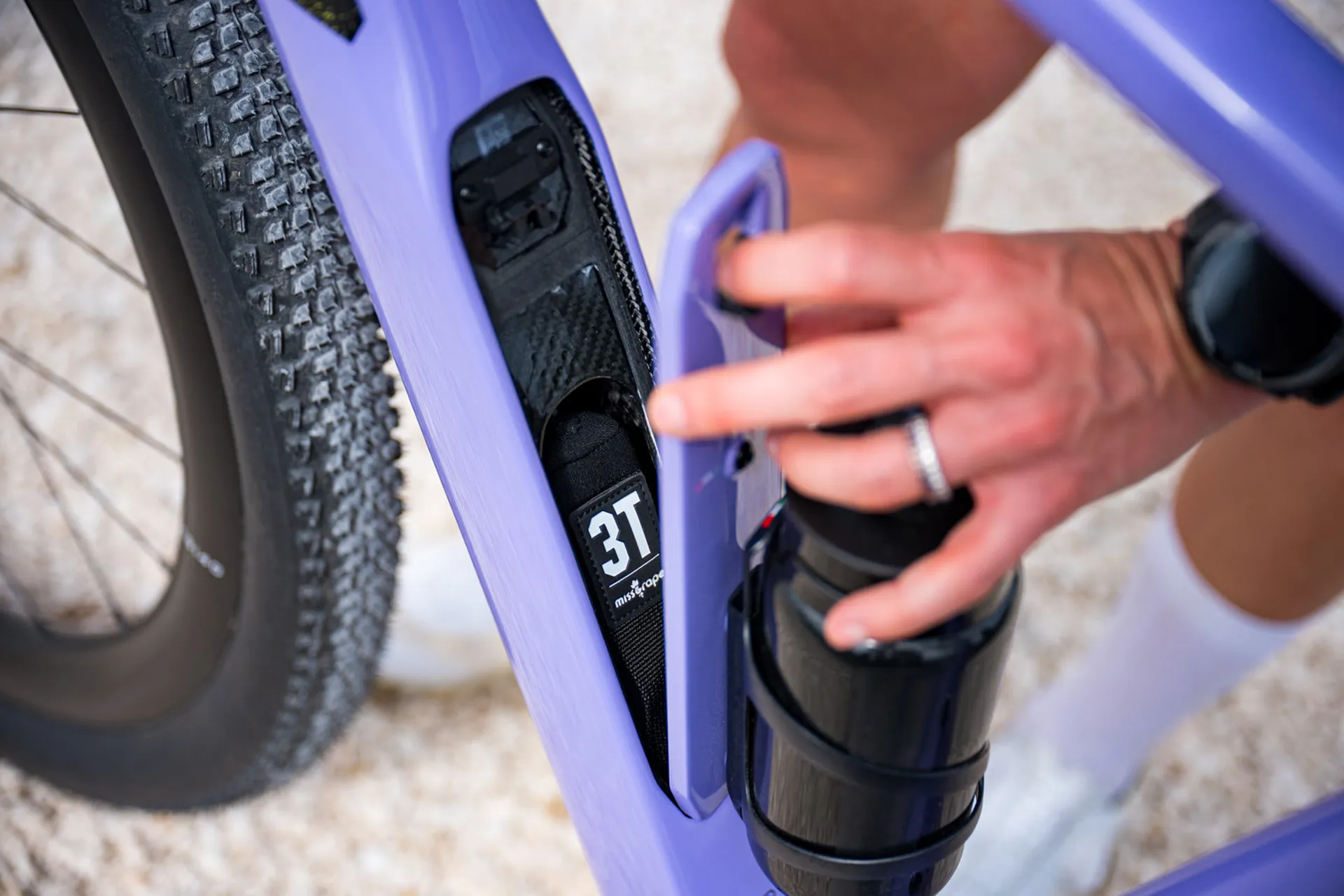
It's a considered and competent ultra-distance build with fewer external bags, fewer bottle-cage compromises, and clean wiring for a dynamo lighting system. Less faff at 03:00 at a checkpoint.
Ultra vs Ultra²: what changed
The first-generation Exploro Ultra (2022) was, fundamentally, a wider-tyre RaceMax. It shared the RaceMax's aero downtube and most of its geometry, with the rider position pulled about 5 mm shorter and slightly more upright than the race bike, and a 419mm chainstay tweaked to balance the bigger rear tyre. Frames were built in Asia. The platform topped out at 46mm 700c (or 55–61 mm 650b) and weighed roughly 8.5 kg in a complete-bike, mid-range build, depending on size.
The Ultra² is a different proposition. It is built in Italy. It is suspension-corrected from the ground up, whereas the original Ultra was a rigid-only design. It opens 700c clearance from 46 mm to 57 mm. It has integrated downtube storage. It uses an updated cable routing standard, and gains a stack increase versus its in-range rivals that the original Ultra never had relative to the original Exploro RaceMax.
Functionally, the change of intent is the most important part. The original Ultra was a fast bike that could go further; the Ultra² is a long-distance bike that happens to be quick. On paper, the second-generation frame asks the rider to give up a little weight and aero polish in exchange for a much wider performance envelope and a more deliberate ergonomic fit for ultra distance and bikepacking. Basically a more dedicated platform.
Where Ultra² sits in the 3T gravel range
With the Ultra² in place, 3T's gravel range now reads cleanly. Three Italia bikes, three jobs:
Model | Mission | HA (M) | Stack (M) | Reach (M) | Rear centre | 700c clearance |
RaceMax² Italia | Aero/road-leaning gravel race | 71.5° (L) | 589 mm (L) | 385 mm (L) | 420 mm | 51 mm (1x) / 48 mm (2x) |
Extrema Italia | Capable race bike, rough terrain | 70.5° | 570 mm | ~372 mm | 436 mm | up to 57 mm WAM |
Ultra² Italia | Endurance / bikepacking; sus-ready | 70.5° | 580 mm (+10 mm vs Extrema) | 368 mm | 437 mm | 57 mm WAM (1x); 50 mm with F 132 ONE; 650b 55–61 mm |
Ultra² vs Extrema Italia
These are the two most easily confused bikes in the 3T range, and the comparison matters because both clear 57 mm of 700c rubber. On the geometry chart they look closer than they ride: in size M both run a 70.5° head angle and roughly equivalent rear centres (Extrema 436 mm vs Ultra² 437 mm). The differences live elsewhere - the Ultra²'s +10 mm stack, +43 mm fork axle-to-crown, longer front centre, internal storage and integrated dynamo routing. The Extrema, by contrast, runs a lower front, no suspension correction, no glovebox (though this is an option); a stack-to-reach ratio of around 1.57 that remains aggressive for a 700c×57 mm gravel frame. It is the bike the 3T-sponsored riders take to events like Unbound XL or The Traka 360 when they want to actually win.
The Ultra² is the bike to take when finishing is the priority and the route is two days long. Higher front end, suspension-ready, more cargo capability, internal storage, an extra 10 mm of stack you will feel in your shoulders by hour eight. It will not match the Extrema in a sprint or in a tight corner, but it is the more sustainable platform across multi-day events and self-supported riding.
Ultra² vs RaceMax² Italia
This is a cleaner comparison. The RaceMax² is the lightest and fastest gravel bike 3T makes - a 990g claimed frame, 380g fork, road-steep 71.5° head angle, 74° seat angle, low stack and long reach. It rivals dedicated road bikes when fitted with 35–40mm low tread tyres, and remains plausible up to 51 mm in 1× configuration. Its bottleneck is exactly that tyre ceiling: there are gravel events the RaceMax² simply cannot run.
The Ultra² gives up perhaps a percentage point of aerodynamic efficiency and a little frame weight, and in exchange offers tyre clearance, a higher and more relaxed front end, suspension compatibility, and the bag mounts and storage to actually live on the bike. It is not a faster bike than the RaceMax² over a flat 200 km road-and-gravel course; it is a more rideable bike over 600 km of mixed terrain.
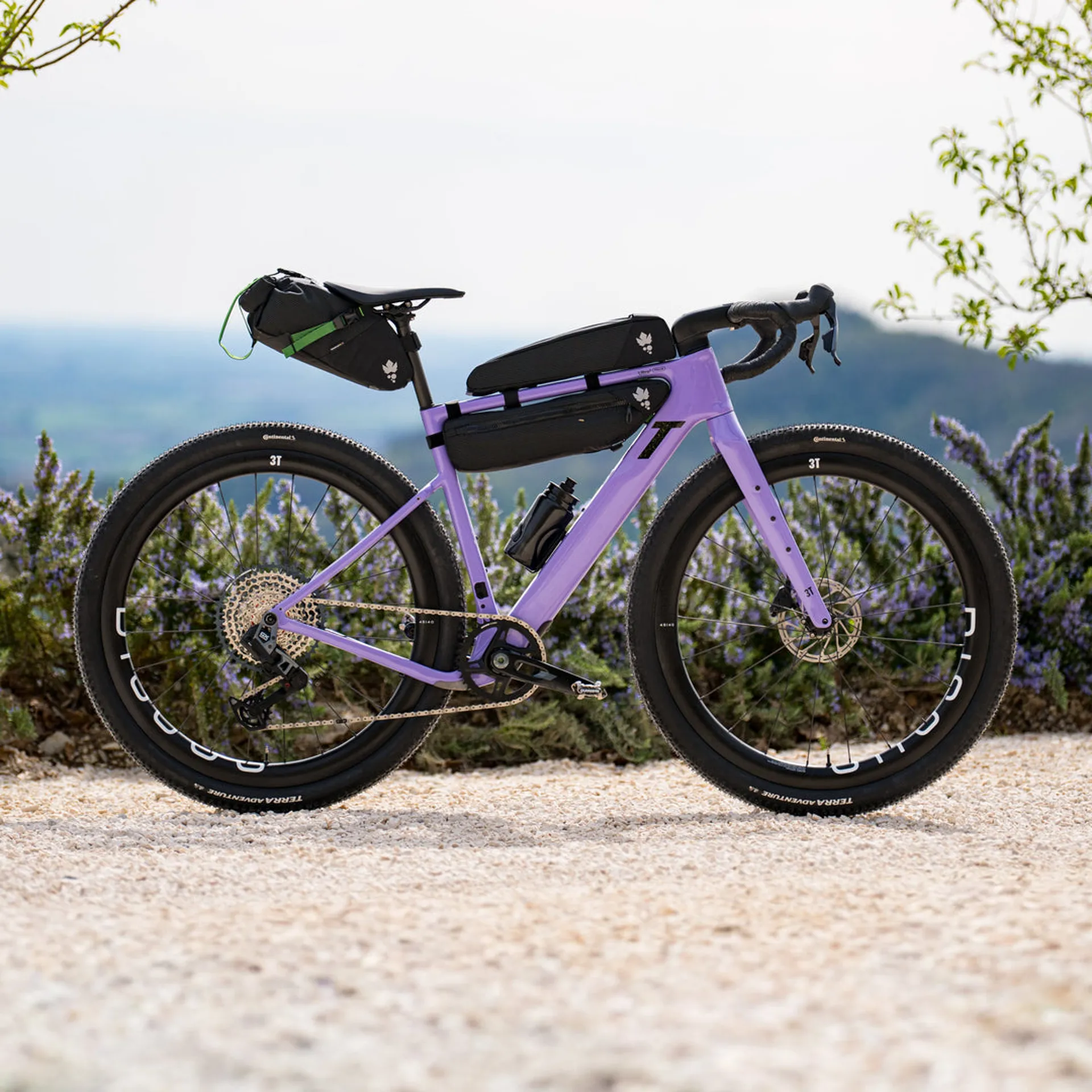
In summary
The Ultra² Italia is the most strategically interesting 3T launch in some time. Three things stand out.
Range clarity. 3T's gravel range is now properly segmented - RaceMax² for speed, Extrema for terrain, Ultra² for distance. Buyers no longer need to guess at the difference between the Exploro Ultra and the Exploro RaceMax.
Fusion Carbon. More than the tyre clearance, this is the structurally important change. Italia provenance at a price point that broadens the audience for 3T's in-house manufacturing.
Suspension as design intent. Designing the frame around the F 132 ONE rather than treating suspension as an after-market option is a clear bet on where ultra-distance gravel is heading.
For the rider, the trade is simple: a small weight penalty versus the Jazz-built RaceMax², a slightly less aggressive front end versus the Extrema, in exchange for more tyre, more stability, more storage and more mounting points. For anyone whose riding leans toward 200km-plus days, mixed surfaces, and self-supported events, the Ultra² is the bike in the 3T range that was missing.
Reference: Ultra² Italia geometry & key specs
Rider heights are guides only.
Frameset specs at a glance
Frame weight (size M, unpainted, ±5%) | 1,199 g |
Fork weight — Fango Ultra² (size M) | 450 g |
Frame material | Fusion Carbon (filament winding + RTM + traditional carbon) |
BB shell | BB386EVO (thread-together recommended, e.g. Token Ninja) |
Disc rotors | 160mm only, front and rear; flatmount direct-fit, no adaptors |
Front thru-axle | Syntace X-12, 100×12 mm |
Rear thru-axle | Syntace X-12, 142×12 mm, UDH |
Headset | Sealed cartridge 52/40, 45° (OD52×ID40×H7) |
Max headset spacer height | 35mm (≤ 20 mm ideal for handling) |
Cable routing | 3T Semi-Integrale Technology |
Cage mounts | Seat-tube, downtube, under-downtube |
Accessory mounts | Triple mounts on each fork leg |
Bag mount | Top-tube |
Internal storage | Downtube glovebox, Fidlock magnetic closure |
Dynamo | Internal routing on Fango Ultra² fork |
Compatible suspension fork | DT Swiss F 132 ONE, 56 mm offset (40 mm travel) |
Seatpost | 27.2mm round; zero-offset 3T carbon included; dropper-compatible |
Tyre clearance — 1× (700c, WAM) | 57mm rigid; 50mm with F 132 ONE |
Tyre clearance — 2× (700c, WAM) | GRX 2×12 mech: 57 mm; GRX Di2 / Campag 2×13: 54 mm |
Minimum recommended tyre | 47 mm RAM |
Max system weight | 110kg (rider + bags) |
Sizes / colours | S, M, L, XL × Avorio / Glicine / Bamboo / Lavico |
Frameset price | £3539 Fango Ultra² carbon fork. £4557 DT Swiss F 132 ONE Suspension Fork |