Two Objectives, No Trade
Road framesets usually pick a side. A climbing frame gives up frontal area to save grams, and an aero frame carries extra carbon to hold its shape in tube sections that have been squeezed thin. ENVE set both targets for the Melee v2 as pass/fail conditions before the project started: benchmark aerodynamics, and a guarantee that a 56cm complete bike could reach the UCI's 6.8kg limit on a SRAM RED build or equivalent.
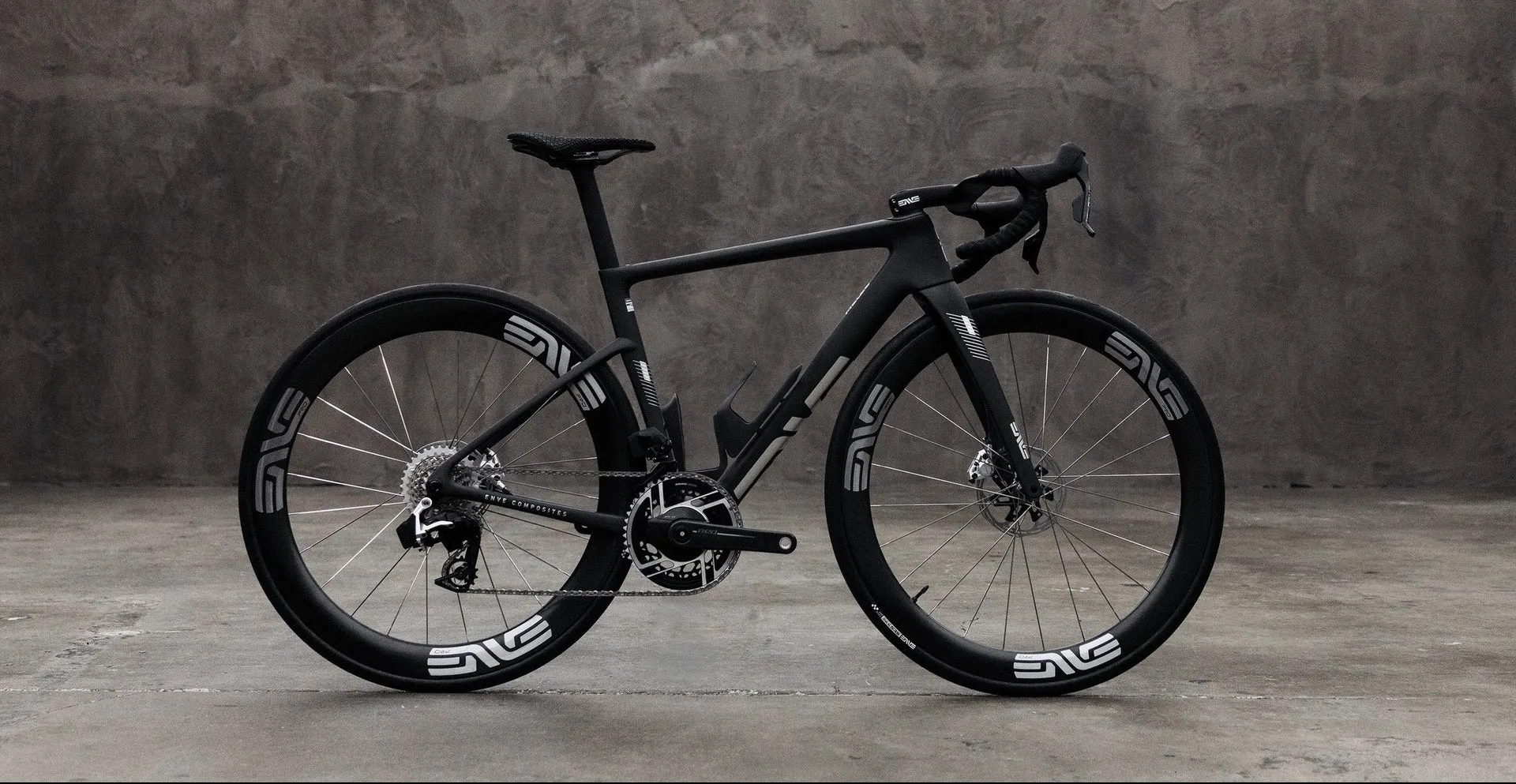
Both were met. A size 56 frame in the Ultralight Black finish weighs 791 grams, and ENVE's own build sheets put a 54 with RED AXS and SES 4.5 PRO wheels at 6.65kg, with pedals, sealant, bar tape and computer mount counted in. The heaviest configuration on that sheet, a 56 on Force with 6.7 PRO wheels, still comes in at just 7.23kg.
Where the Weight Was Won
The original Melee arrived in 2022 as ENVE's first production road bike, at a claimed 850 grams for a painted 56, plus or minus two percent. The v2 takes 59 grams out of that figure, and it does so through four changes rather than a wholesale rethink.
The bottom bracket moves from a T47 inboard-bearing shell to a threaded BSA in the standard 68mm road width, which ENVE describe as 30 percent lighter than the shell it replaces. It is also a bottom bracket any mechanic can service with tools they already own. The headset changes from an IS52/IS52 1.5in drop-in arrangement to a much smaller 40.5 by 49.5 by 6.5mm bearing at 45/45, which is what allows the new head tube to be as slim as it is. Those bearings run LLU seals and permanent waterproof grease, so the weight saving does not arrive at the cost of service life. If you want fit and forget ,then the CeramicSpeed SLT option The seatpost is new, with a two-bolt head that saves 28 grams and keeps its hardware captive while a saddle is being fitted. And the whole frame carries 7.5 percent less total surface area than the original, which is material removed from the airflow and from the scales at the same time.
Tyre clearance comes down with it, from 35mm to 33mm, with 31mm quoted as optimal. That is a deliberate narrowing rather than an oversight. A 35mm gap has to be built around, and the structure that surrounds it costs both grams and drag, while 31 to 33mm covers what a road race actually calls for.
The finish is worth its own mention. Ultralight Black is a clear coat over raw carbon with minimal graphics, and ENVE put the penalty of that finish at 31 grams in both the launch deck and their own collection page. It is the difference between a frame that starts with 800 grams in reach and one that does not, and it is why the sub-800 number is quoted against that colour specifically.
Developed With a Rider on the Bike
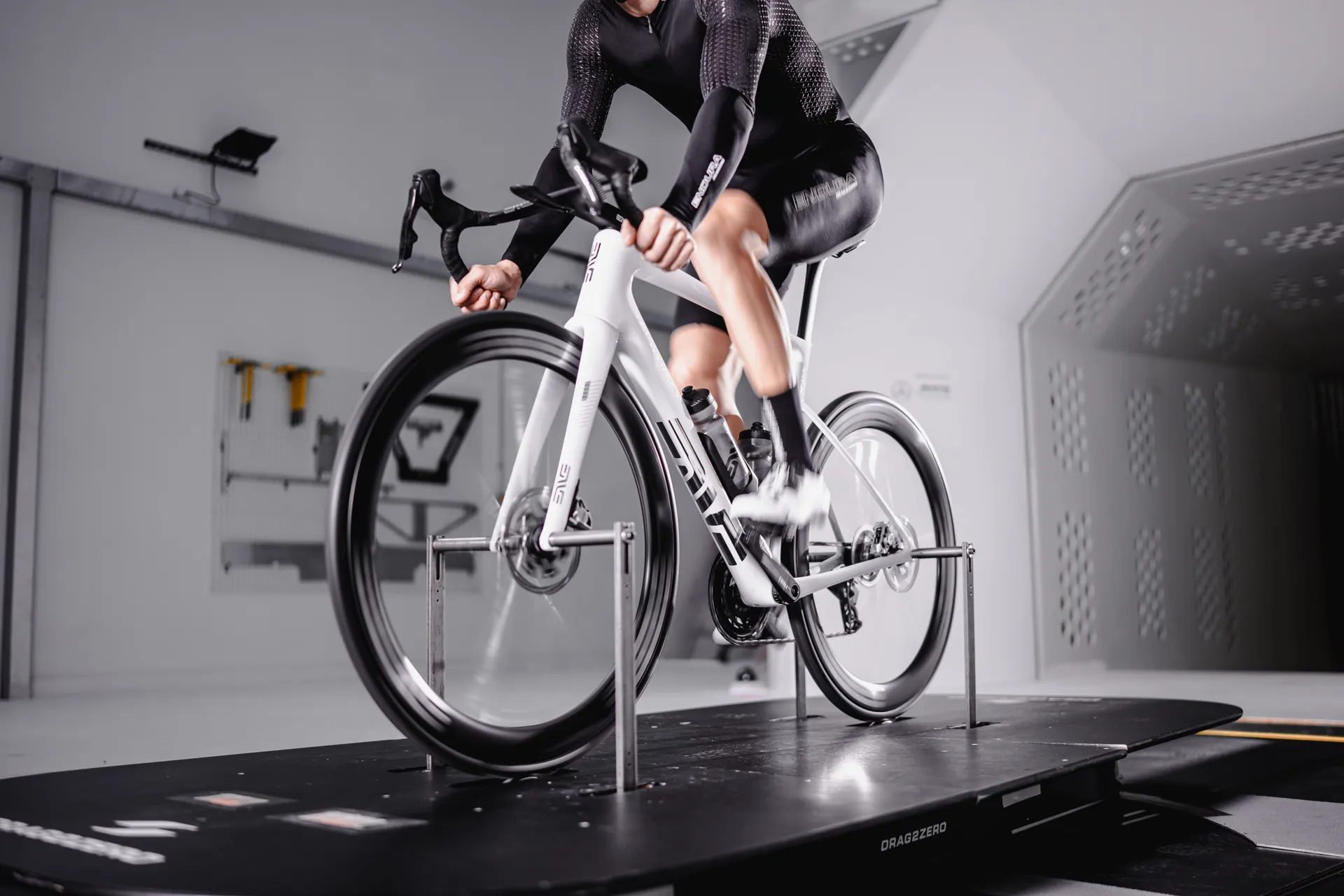
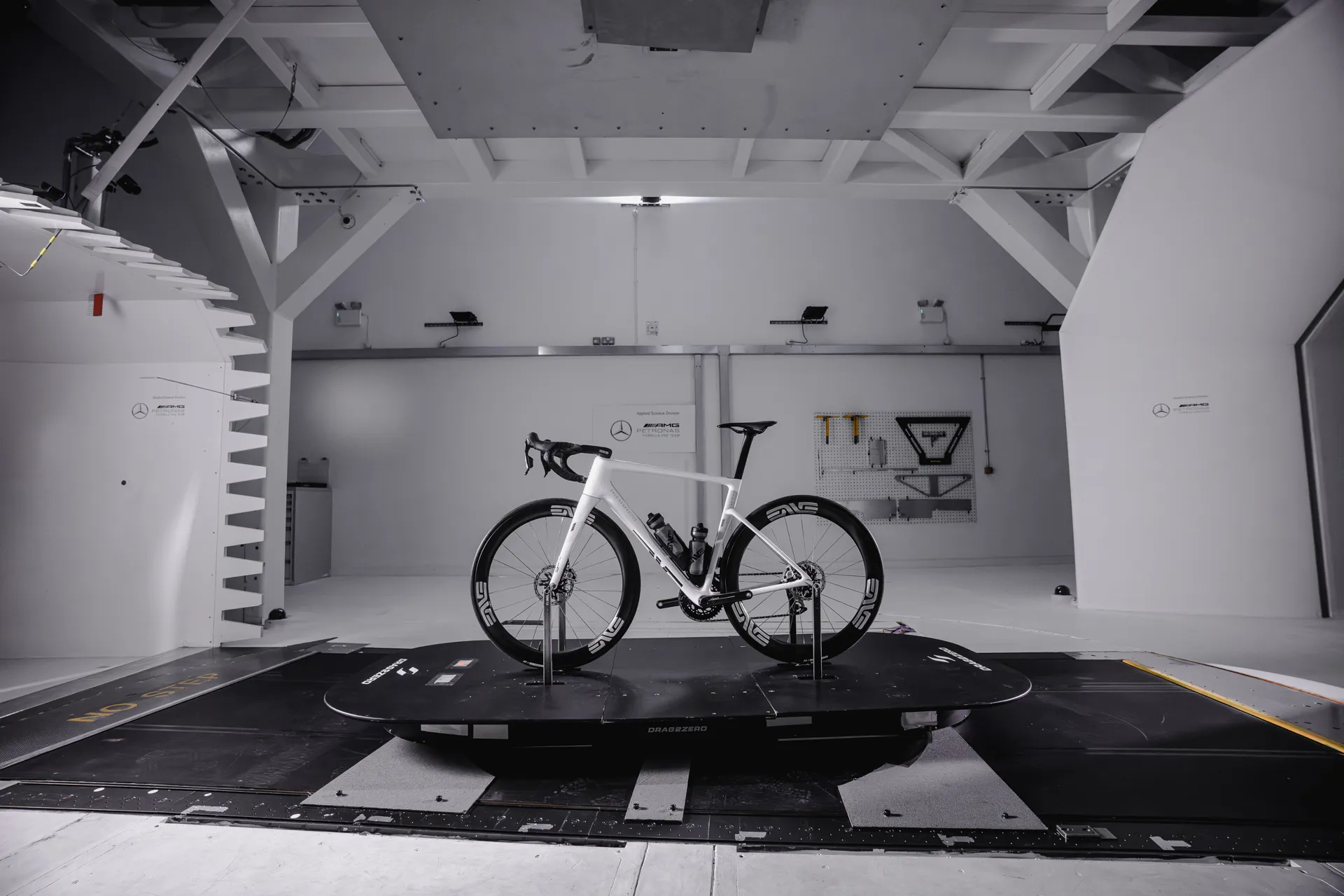
ENVE call their development protocol Real-World Fast™, and the Melee v2 is the first frame designed from the ground up under it. Their own summary of it is that speed is a system, and the Melee v2 is the first ENVE frame designed on that basis from the first sketch. Testing ran at the Mercedes-AMG PETRONAS wind tunnel at Silverstone, with tube shapes and components developed alongside aerodynamicist and long time partner, Simon Smart.
The protocol has one requirement that changes the numbers it produces. Every configuration is validated with a rider onboard, using real riders rather than mannequins, with hand position, body position and cadence controlled on video and all equipment standardised across sessions. Bottles and cages are fitted. Rim shapes are ENVE's own SES profiles, so the frame is developed against the wheels it will likely be ridden with.
ENVE are direct about why this matters. A rider's legs generate turbulence and dam up airflow behind them, so a tube shape that performs in isolation can be working into disturbed air the moment a rider sits on the bike. Very deep aero profiles test well and do not always translate. The job of the frame is to let air progress across the rider's legs and onto the back half of the bike and the rear wheel.
The Wind Tunnel Numbers
ENVE ran three comparisons, all at 50kph.
Taken as bare bikes with no bottles or cages, the Melee v2 measured 111.94 watts of average drag against 116.08 for a Specialized SL8 and 121.34 for a Trek Madone.
Fit two standard bottles and cages, which is how nearly every road bike is ridden, and the order holds while the gaps change. The Melee v2 rises to 115.38 watts, a penalty of 3.44 watts for its hydration.
The Madone, running Trek's own aero bottles and cages rather than standard ones, sits at 118.89. The SL8 with standard bottles reaches 120.83. A frame that is quick when bare is not necessarily quick once a rider fills the cages before a race, and this is the comparison that reflects what happens on the road.
The third test puts a rider on each bike, with bottles and cages fitted. The Melee v2 recorded 507.71 watts. The Madone with its aero bottle system managed 510.79, the SL8 with standard bottles 511.30, and the Madone on standard bottles 517.90. The original Melee, in the same configuration, measured 524.71 watts.
That last figure is the one that matters to anyone upgrading. The gap between the two generations is exactly 17 watts with a rider aboard, and ENVE attribute it across the package rather than claiming it all for the frame. The chassis accounts for 11.4 watts, and that saving applies however the bike is specified. Three watts come from the cockpit and its bar tape, measured on the SES Aero PRO v2 with ENVE's new Aero Race Tape. The remaining 2.6 watts come from the SES Aero Bottle Cages with bottles fitted, and those cages are a separate purchase that will work on almost any road bike, including an original Melee.
The Kit and the Cockpit
ENVE's own one-pager lists the Melee v2 frameset as frame, fork, IN-Route headset and the Melee v2 aero seatpost, the latter at 400mm with zero offset. The frame kit as supplied includes the cockpit, chosen and sized with the rider when the order is placed.
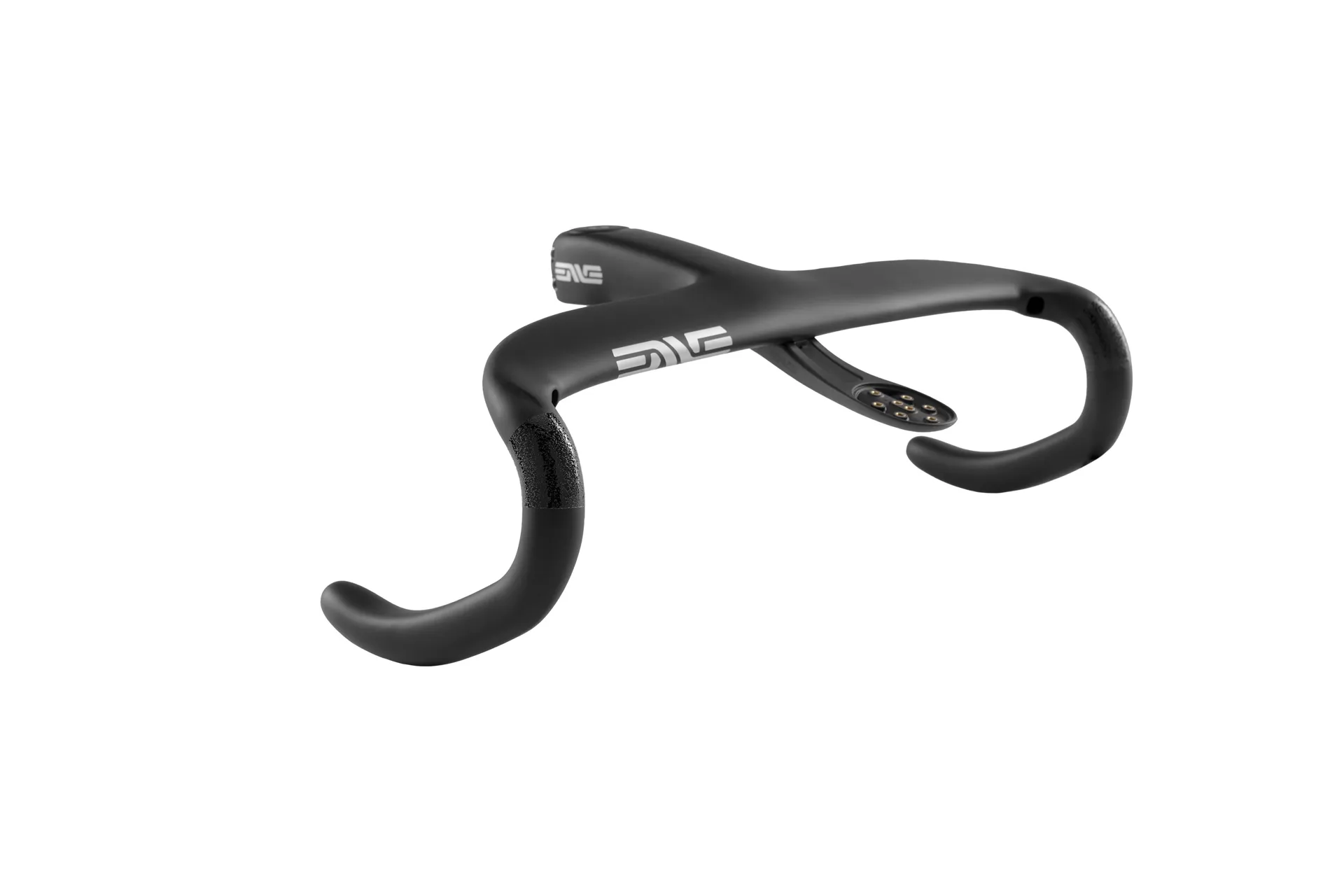
Most riders will take the one-piece route, and there are two ways to do it. The SES Aero PRO v2 is the new cockpit, developed with UAE Team Emirates alongside the frame, and it is the one ENVE measured for the three watts above. Its Aergonomic drop carries an airfoil cross section that is only fully realised once the included pad is fitted, and that pad damps road vibration at the same time. Aero Race Tape and pads come in the box. Eighteen combinations cover stems from 90 to 140mm against hood and bar-end widths of 37/40, 39/42 and 41/44, with 76mm reach, 128mm drop, 1.5mm of flare per side and a minus seven degree stem angle. Weight runs 335 to 355 grams depending on size, and it is IN-Route compatible.
The SES AR is the established alternative, and the bar whose drop shape the new Aergonomic profile takes its lead from. ENVE specify it on their own Premium and Foundation builds. They have not published a separate Melee v2 drag figure for it, so the three watts above belong to the PRO v2 and are not claimed here. Both keep the front end clean, with no clamp interface and no spacer stack on show, which is a large part of the reason riders choose an integrated cockpit at all.
Numerous Enve two-piece bar and stem combinations will also fit, and the reason to go that way is fit rather than speed. A separate bar and stem allows width and length be chosen independently and changed later without replacing the whole cockpit, which suits a rider still settling a position, or one whose numbers fall between the available one-piece sizes. A two-piece build claims the 11.4 watt chassis saving and stops there, because that is what has been measured.
Whichever route is taken, the frame, fork, seatpost and headset are identical and the 11.4 watts is unaffected.
Stiffness and Ride
Chasing weight and drag together usually costs stiffness somewhere. ENVE tested frame deflection under load against the original Melee and the v2 deflects less, by roughly a fifth. The chart is published without values, so no numbers can be quoted here!
What that means on the road is a more direct response under power, which is the point of a race frame. The Melee has never been a comfort platform and the v2 leans further into that. Geometry has been revised for racing, with stack dropping five millimetres on the 56, 58 and 60, and the new cockpit accounting for a further six, so a taller rider sits eleven millimetres lower at the front than on the equivalent original. Seat tubes on the larger sizes are longer, which widens the usable saddle height range.
Five fork rakes are spread across the seven sizes, as they were on the original, which keeps trail inside a narrow band from the 47 to the 60. A 47cm frame runs 55mm of rake and a 60 runs 39mm, and the sizes in between step through 51, 47 and 43. The result is that the bike steers with the same character whichever size a rider ends up on, rather than becoming twitchy at the bottom of the range and vague at the top.
ENVE's Best Fit Calculator works from rider measurements rather than frame size, and returns the size, stem length, saddle offset and spacer stack needed to hit a given stack and reach. It is worth running before committing to a size, and we are happy to work through the output with you. The full geometry chart is at the foot of this page. As always however, there is no substitute for a full bike fit as it assumes nothing and is far more tailored than numbers created around a generic human!
The Cockpit and Cage Components
The Aero Race Tape weighs 58 grams and measures 1.2mm thick, supplied as two 200cm rolls in black. Its velvet-finish microfibre construction grips in the wet or dry, while putting less material into the wind, and it is cut for the three-quarter wrap an aero bar wants. It comes with the SES Aero PRO v2, which makes it a spares and retrofit item as much as a first purchase, though at the time of writing, it is not yet available separately.
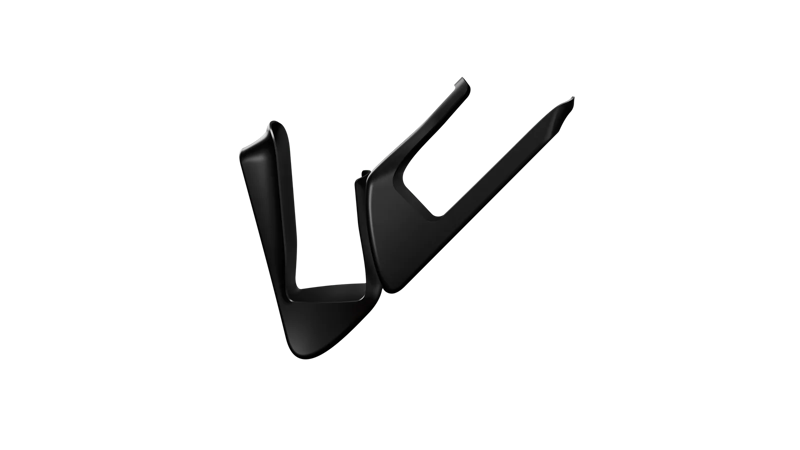
The SES Aero Bottle Cages weigh 63 grams each and are made from carbon, in ENVE matte black or gloss white. The down tube and seat tube cages are shaped differently, because the airflow at each position is different, and both take standard round bottles rather than a proprietary shape. ENVE quote up to 2.5 watts of drag reduction for the cages themselves, and 2.6 watts for cages and bottles together within the 17 watt system figure. They fit most road bikes, so they are as relevant to an original Melee or another brand's frame as they are to a v2.
Complete Builds
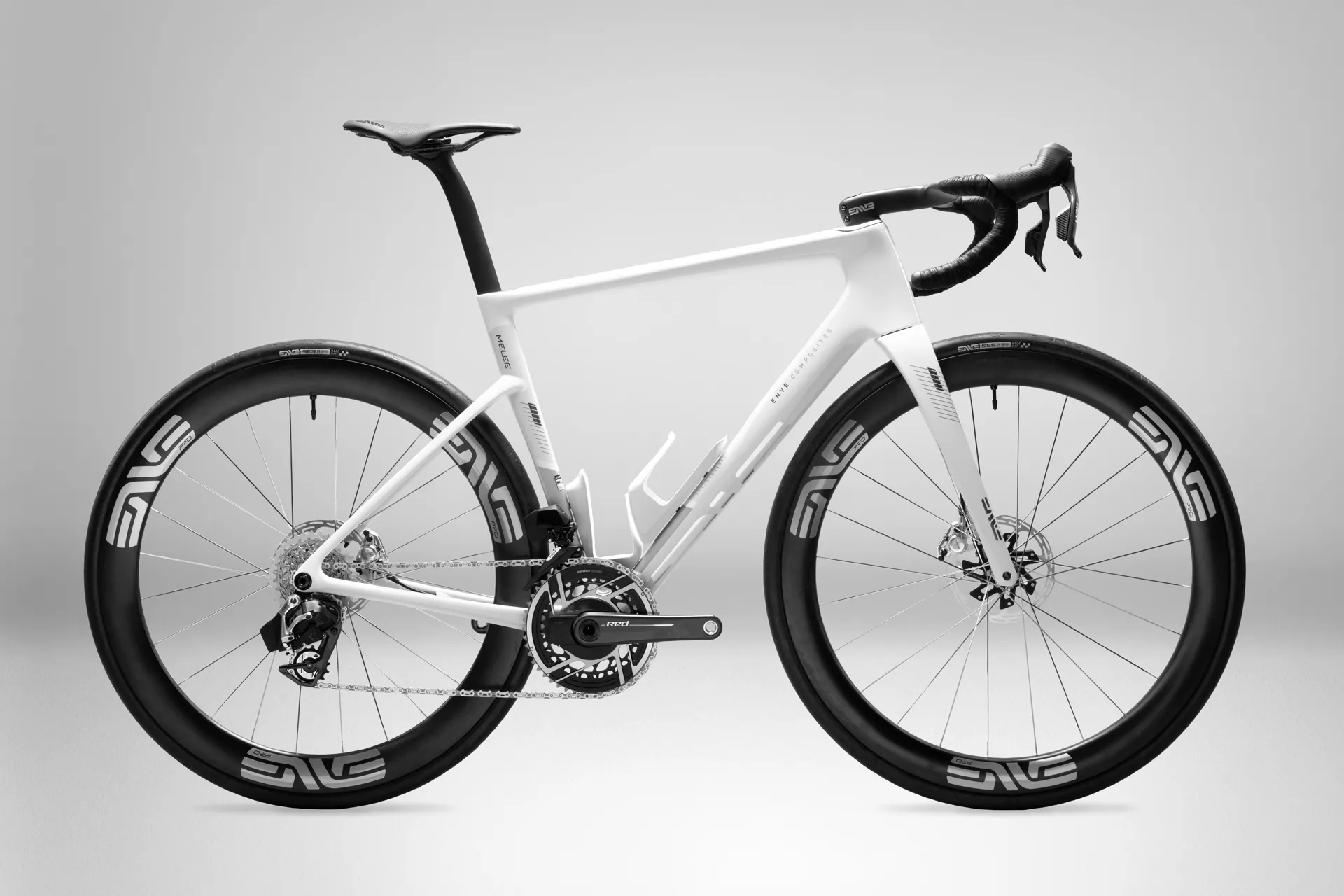
ENVE's Spec'd for Speed programme builds the bike to the rider's specification from the start, rather than leaving parts to be swapped out afterwards. Multiple builds are available using SRAM Force or Red, or Shimano Dura Ace or Ultegra. Wheels then become the differentiator and will govern a chunk of the cost. Options are Foundation, SES or SES PRO series and ENVE listed complete builds run from £10,149 to £16,099. Powermeters are standard on SRAM builds and optional on Dura Ace.
If you prefer to spec your own, Frame Kits start from the standard Frame, Fork, Headset, seatpost and cockpit at £5299.
Key Numbers
| Melee v2 | Original Melee |
|---|
Frame weight, size 56 | 791g in UL Black. ENVE quote 750–850g across the range | 850g ±2%, painted |
Chassis weight | 1,442g with fork, headset, seatpost, thru-axles and hangers | Not published |
Drag, rider aboard, 50kph | 507.71W | 524.71W |
System saving | 17W total: 11.4W chassis, 3W cockpit and tape, 2.6W cages and bottles | Baseline |
Frame surface area | 7.5% less | Baseline |
Bottom bracket | BSA threaded, 68mm | T47 inboard bearing |
Headset bearings | 40.5 × 49.5 × 6.5mm, 45/45 | IS52/IS52, 1.5in drop-in |
Seatpost | Melee v2 aero, 400mm, zero offset, two-bolt head, 28g lighter | ENVE Aero |
Tyre clearance | 33mm maximum, 31mm optimal | 35mm maximum |
Rear derailleur hanger | UDH | Not published |
Frame and fork material | ENVE M.O.D. Carbon | ENVE M.O.D. Carbon |
Front derailleur | Bolt-on, braze-on mount | |
Cable routing | ENVE IN-Route internal, mechanical compatible | |
Thru-axles | 12 × 100mm front, 12 × 142mm rear | |
Brake mount | Flat mount, 160mm rotor only | |
Sizes | 47, 50, 52, 54, 56, 58, 60 | 47 to 60, seven sizes |
Fork rake by size | 47/55, 50/51, 52/47, 54/47, 56/43, 58/43, 60/39 | Same five rakes |
Frameset contents | Frame, fork, seatpost, IN-Route headset. Our kit adds bar and stem | |
Finishes | UL Black, White Lightning | |
Warranty | Limited Lifetime Warranty and Crash Replacement | |
Geometry
| 47 | 50 | 52 | 54 | 56 | 58 | 60 |
|---|
Reach | 367.6 | 374.6 | 380.7 | 386.7 | 393.3 | 400.1 | 407.5 |
Stack | 501.7 | 517.4 | 532.9 | 547.4 | 564.7 | 584.9 | 610.4 |
Seat tube (c–t) | 421.4 | 442.1 | 464.5 | 479.7 | 502.9 | 522.4 | 554.2 |
Top tube (effective) | 502.1 | 518.1 | 533.5 | 546.2 | 560.6 | 576.7 | 597.1 |
Seat angle | 75.0° | 74.5° | 74.0° | 73.8° | 73.5° | 73.2° | 72.8° |
Head angle | 70.8° | 71.5° | 72.3° | 72.5° | 73.2° | 73.2° | 73.8° |
Head tube | 97.5 | 110.1 | 122.2 | 138.8 | 153.3 | 176.5 | 199.5 |
BB drop | 75 | 75 | 75 | 73 | 73 | 71 | 71 |
BB height | 267.4 | 267.4 | 267.4 | 269.4 | 269.4 | 271.4 | 271.4 |
Chainstay | 410 | 410 | 410 | 410 | 410 | 412 | 412 |
Front centre | 579.3 | 581.4 | 581.1 | 590.3 | 591.7 | 604.8 | 609 |
Wheelbase | 977.6 | 979.6 | 979.3 | 989.2 | 990.6 | 1006.5 | 1010.7 |
Standover (100mm) | 717.7 | 735.4 | 754.0 | 770.4 | 790.3 | 811.5 | 839.4 |
Fork rake | 55 | 51 | 47 | 47 | 43 | 43 | 39 |
Trail (25mm tyre) | 58.6 | 58.6 | 57.8 | 56.7 | 56.7 | 56.7 | 56.9 |
Trail (29mm tyre) | 60 | 60 | 59 | 58 | 57.9 | 57.9 | 58 |
Trail (33mm tyre) | 61.4 | 61.3 | 60.3 | 59.3 | 59.2 | 59.2 | 59.2 |
All measurements in millimetres unless stated. ENVE also publish trail figures for 27mm and 31mm tyres.