One Frame. Every Path.
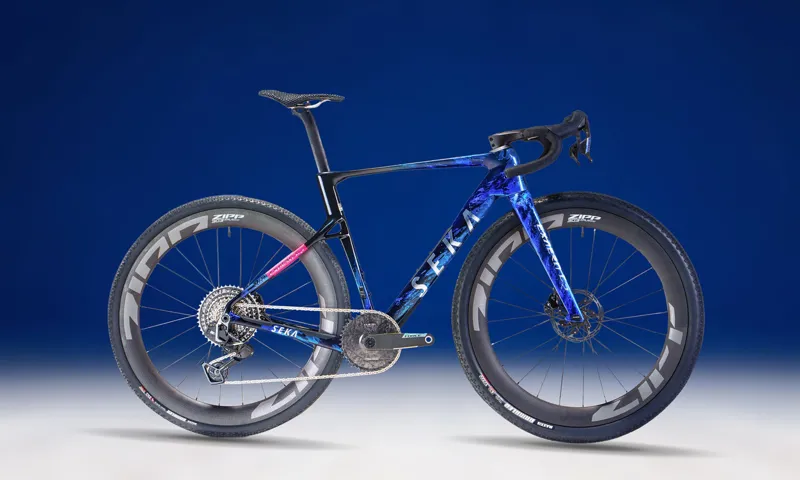
That is SEKA's stated ambition for the ExAero GR, and the engineering behind it is substantial. The ExAero GR was designed from first principles to win gravel races - not to approximate road bike performance on rougher surfaces, but to be the fastest and most capable platform available for the specific demands of competition gravel riding.
Those demands are not simple: they require aerodynamic efficiency across long stages where small gains compound significantly, structural resilience against the unpredictable loads of rough terrain, tyre clearance wide enough to handle varying course conditions, and the ability to carry nutrition, tools and emergency kit without compromising the aerodynamic profile that makes sustained high average speeds possible. The ExAero GR addresses all four simultaneously rather than trading one against another.
The frame's development followed the same systematic approach SEKA applied to the Spear - CFD analysis establishing the core aerodynamic design direction, followed by wind tunnel validation at the Silverstone Sports Engineering Hub in collaboration with AeroCoach - and the results are competitive with anything currently available in the category. Wind tunnel testing, conducted using the Barry (2018) weighted yaw-angle averaging protocol, measured the ExAero GR at a CdA of 0.3938m² in its real-world race configuration with 45mm tyres.
For reference, the Spear road bike in its equivalent real-world setup (28mm tyres, Zipp 404 Firecrest wheels) measured 0.3820m². The 9.9-watt difference between them is attributed primarily to the wider tyre and wheel combination rather than the frame itself - and it is bridged substantially by the ExAero GR's integrated storage system, which eliminates the need for the external saddlebag that would add approximately 2.5 watts to the Spear's drag in an equivalent carrying configuration.
Aerodynamics: Designed as a Complete System
Most aerodynamic development for gravel bikes focuses on the frame's drag coefficient in isolation. SEKA's approach with the ExAero GR was to optimise the entire system in its real-world racing configuration - frame geometry, tyre clearance, integrated storage and the modular mounting interfaces considered together rather than separately.
CFD analysis guided the development of tube cross-sections, transitional zones between tubes, and the rear wake structure. The focus areas were the integrated handlebar and fork interface at the front end, the overall pressure distribution across the complete bike, wake management through the Wind Eye structure at the rear, and the aerodynamic relationship between the down tube profile and the ExAero Mag bottle system. Multiple rounds of CFD iteration preceded wind tunnel testing, and the final tunnel results validated the simulation closely enough to confirm that the virtual design process had accurately predicted real-world performance.
The ExAero Mag aero bottle system is a direct product of this whole-system thinking. Wind tunnel testing quantified the aerodynamic delta between the proprietary aero bottles and standard round bottles under identical conditions: two ExAero Mag bottles reduce CdA by 0.0074m² compared to two standard round bottles, a saving of 5.7 watts at 39km/h and 8.7 watts at 45km/h. A single ExAero Mag saves 4.6 watts at 39km/h. The aerodynamic advantage derives from the co-optimised geometry between the bottle's cross-sectional profile and the down tube shape - the bottle functions as an extension of the tube rather than an obstruction placed in front of it, reducing the turbulent wake area and minimising localised pressure drag.
The Wind Eye: Redesigned for Gravel
The Wind Eye structure that defines the rear triangle of the Spear is also central to the ExAero GR, but it is not a direct transfer. The demands of gravel riding - wider tyres, dual chainring compatibility, rougher terrain loads - imposed different constraints on the rear triangle, and SEKA redesigned the structure accordingly.
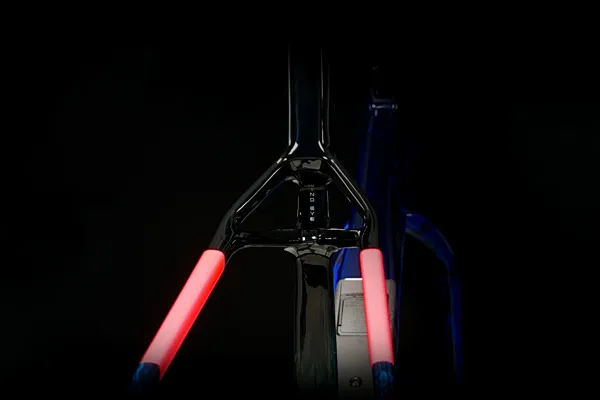
The most significant challenge was spatial: accommodating 52mm rear tyre clearance with dual chainring compatibility on the drive side requires a chainstay that narrows to just 11mm at its thinnest point, which would compromise rear triangle lateral stiffness in a conventional design. SEKA addressed this through targeted structural iteration of the Wind Eye's upper and lower connecting plates, thickening them across multiple design cycles to restore the lateral support lost to the narrower chainstay profile.
The three-dimensional space formed by the Wind Eye's plates also serves as an airflow diffuser in this configuration, managing the turbulent wake behind the seat tube in the same way it does on the Spear. CFD optimisation was performed on the cross-sectional profiles and angles of the connecting plates after the structural reinforcement to ensure that the aerodynamic performance was preserved - the total aerodynamic drag increase from the structural changes is less than 1 watt under a 45km/h relative wind speed across the ±20° yaw range tested.
The outcome is a rear triangle with 25.63 N/mm lateral stiffness - fractionally better than the benchmark SEKA Spear in testing - and 106 N/mm vertical compliance. For long-distance gravel racing on variable terrain, where sustained high-intensity efforts alternate with rough descents and loose surface sections, the combination of precise power transfer and progressive compliance absorption is what allows a rider to maintain pace deep into a race.
Materials: Built for Terrain, Not Just Weight
The ExAero GR uses a different carbon strategy to the Spear, and the reasoning behind that difference is worth understanding directly.
The Spear's carbon schedule is built around pitch-based ultra-high modulus fibres - DIALEAD PITCH 65T and PITCH 80T - selected for their extraordinary stiffness-to-weight properties in a road racing context where the loads are broadly predictable and the premium is on minimum weight at maximum structural efficiency. A gravel racing frame operates under fundamentally different loading conditions. Rough terrain, gravel impacts, vibration and shock loads impose stress patterns that are more variable, less predictable and higher in peak energy than road racing loads, and the failure mode of ultra-high-modulus fibres under those conditions is less forgiving than in the controlled environment of a road race.
SEKA's response was to build the ExAero GR around TORAYCA T1100G and TORAYCA M46J as the primary reinforcement materials - PAN-based fibres that offer significantly higher tensile strength and fracture toughness than pitch-based alternatives. Compared to pitch-based carbon, T1100G and M46J allow the frame to absorb and distribute impact energy more effectively without sacrificing the stiffness-to-weight ratio that competition demands. The trade-off is a marginal weight increase: the ExAero GR comes in at 980g for a size 54 frame with metal parts and paint excluded, reached after successive iterations that evolved the frame weight from an initial 900g target as critical stress zones were systematically reinforced to meet both ISO 4210 and the more demanding ASTM Condition 2 standards.
SEKA set targets above both standards and validated to their own internal specification. The 980g figure represents the optimised balance between lightweight performance and the impact strength and fatigue life required for demanding terrain.
The front triangle uses the same True-One-Piece Moulding process as the Spear - a continuous monocoque structure rather than bonded sections - which maintains the uninterrupted load path that maximises the performance of the carbon at every point and delivers the superior impact resistance and fatigue life that matters most when a frame is ridden hard across unpredictable surfaces over multiple race days.
Storage and Modularity: Carry What You Need. Lose No Speed.
In long-distance gravel races, self-sufficiency is a performance factor. Riders need to carry nutrition, tools and emergency kit across stages where resupply is limited and mechanical support is unavailable. The conventional solution - external saddle bags and frame bags - is functional but aerodynamically expensive. Wind tunnel and CFD data show that a 1-litre externally mounted saddlebag increases effective frontal area (CdA) by approximately 0.003m², producing a power penalty of around 2.5 watts at 40km/h - a time loss of roughly 20 seconds over an 80-kilometre course under constant power.
The ExAero GR eliminates this penalty through a fully integrated down-tube storage compartment engineered to carry spare tubes, CO2 cartridges, tools and essentials in an aerodynamic form that works with the frame's tube profile rather than against it. The compartment uses a Fidlock magnetic latch for a clean, secure interface that functions reliably in race conditions without rattling or losing grip on rough terrain.
Beyond the integrated compartment, a modular mounting system provides four additional configuration points: a top tube mount for quick-access nutrition - gels, bars or a phone pouch - a down tube/BB mount for a tool capsule or additional water bottle, and a rear seatpost mount for clothing, rain gear or a race number plate. Riders can equip every mount for a long ultra-endurance stage or strip back to the minimum for a shorter, faster circuit race. The system is designed to accommodate the full range of competitive gravel events, from 80-kilometre UCI circuit races to multi-day self-supported ultras, without requiring different frames or incompatible accessories.
Gladius GR Integrated Handlebar
The Gladius GR is the ExAero GR's purpose-engineered handlebar system, developed specifically for the demands of gravel racing rather than adapted from a road-oriented design. Fifteen size combinations are available across three widths and five stem lengths - 380/440mm, 400/460mm and 420/480mm (hoods/drops) paired with stems from 80mm to 120mm - giving riders a precise fit across a wide range of proportions and riding styles without compromise. Width is measured at the upper section; the drops flare outward by 16° on each side, which broadens the lower grip position to improve wrist ergonomics and increase mechanical control on technical terrain, particularly on loose descents where the hands are in the drops and steering precision matters most.
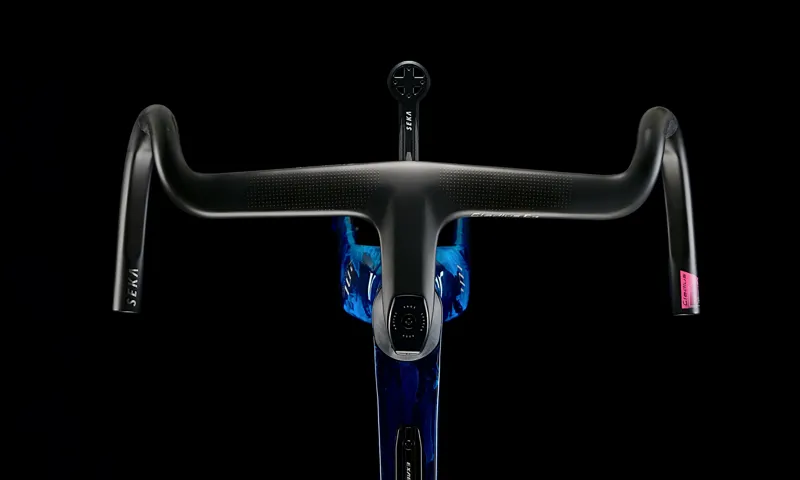
A slight backsweep in the bar design increases the forward reach space, which is particularly useful for riders positioning further back on the saddle on climbs. The tops feature a micro-textured anti-slip surface that maintains grip in wet conditions or when hands are muddy - a detail that reflects the specific context the bar was designed for. Weight for the 400/460mm-90mm combination is approximately 395g. The Gladius GR is compatible with the Rapier computer mount, providing a consistent mounting interface across the SEKA range.
Geometry: Agile, Confident, Consistent
The ExAero GR's geometry is designed around a specific handling philosophy: direct steering feedback and predictable control across terrain that changes rapidly and without warning. The key calibration point is trail, which runs from 71mm in size 49 down to 60mm in size 61 (measured at 350mm wheel radius with 40mm tyres). That progression delivers genuinely agile, responsive steering across the size range without crossing into nervousness, and the consistency of the trail figure across six sizes means that handling character does not shift significantly as riders move up the size range.
Complementing the trail calibration is a bottom bracket drop of 74-70mm and a front-centre and wheelbase optimised for stability at speed on rough surfaces. Chainstay lengths run from 460mm in size 49 to 580mm in size 61, giving larger sizes the wheelbase stability that longer, heavier riders need on descents while keeping the shorter sizes nimble and quick to respond on tighter terrain. Two seatpost offset options - 0mm and 15mm setback - allow further fine-tuning of the seated position without requiring a different frame size.
Six frame sizes run from 49 to 61, with rider height guidance from 150-162cm to 194-207cm. Refer to the geometry chart below for full measurements.
SEKA ExAero GR — Geometry
6 frame sizes. Geometry calibrated for agile handling and confident stability on rough terrain. Trail 71–60mm across the range.

| Measurement | 49 | 52 | 54 | 56 | 58 | 61 |
|---|
| Rider height (cm & ft) | 150–162
4'11"–5'4" | 160–172
5'3"–5'8" | 170–180
5'7"–5'11" | 178–188
5'10"–6'2" | 186–196
6'1"–6'5" | 194–207
6'4"–6'9" |
| Stack (mm) | 524 | 540 | 559 | 579 | 602 | 620 |
| Reach (mm) | 369 | 375 | 381 | 389 | 399 | 408 |
| Seat tube C–T (mm) | 509 | 526 | 541 | 555 | 578 | 598 |
| Head tube length (mm) | 96.4 | 111 | 132 | 152 | 176.5 | 195 |
| Head tube angle (°) | 70.4 | 71.0 | 71.3 | 71.6 | 72.0 | 72.2 |
| Seat tube angle (°) | 75.0 | 74.3 | 74.0 | 74.0 | 73.5 | 73.0 |
| Wheelbase (mm) | 999 | 1005 | 1016 | 1027 | 1042 | 1055 |
| Chainstay (mm) | 423 | 423 | 423 | 423 | 423 | 423 |
| Front center (mm) | 587 | 593 | 603 | 615 | 628 | 641 |
| Fork offset (mm) | 50 | 50 | 50 | 50 | 50 | 50 |
| BB drop (mm) | 74 | 74 | 72 | 72 | 70 | 72 |
| Trail (mm) | 71 | 67 | 65.5 | 63.5 | 61 | 60 |
| Fork axle-to-crown (mm) | 401 | 401 | 401 | 401 | 401 | 401 |
| Standover height (mm) | 747 | 771 | 792 | 815 | 837 | 858 |
Sizes 49–61 (cm). 6 frame sizes. Fork offset and BB height constant across all sizes.
All measurements in mm unless otherwise noted. Trail values shown for 40mm tyre width — actual trail varies with tyre width and pressure. Fork A–C = 401mm (constant). Fork offset = 50mm (constant).
The ExAero GR at 7hundred
The ExAero GR is stocked at 7hundred as a frameset, giving riders the option to build it to their own specification - groupset, wheels and components chosen to match their racing programme, budget and existing equipment. For riders targeting the growing calendar of UK and European gravel events, from UCI Gravel Worlds to Unbound-format ultras, the ExAero GR is the most complete and aerodynamically serious platform available at this price point. It arrives with the Gladius GR integrated handlebar included.
Frameset Specifications
| Specification | Detail |
|---|
| Frame Weight | 980g (size 54, metal parts and paint excluded) |
| Bottom Bracket | T47 threaded |
| Front Tyre Clearance | 56mm maximum |
| Rear Tyre Clearance | 52mm maximum |
| Wheel Size | 700c |
| Fork Axle-to-Crown | 423mm |
| Fork Offset | 50mm |
| BB Height | 401mm (constant across sizes) |
| Seatpost Offset Options | 0mm or 15mm setback |
| Down-Tube Storage | Integrated compartment with Fidlock magnetic latch |
| Modular Mounts | Top tube / Down tube-BB / Rear seatpost |
| In the Box | Frame, fork, seatpost, Gladius GR integrated handlebar |
Key Features & Benefits
| Feature | Benefit |
|---|
| CdA of 0.3938m² (45mm tyres) | Aerodynamically within 9.9W of the Spear road bike - the most aerodynamic gravel frame in this category |
| ExAero Mag aero bottle system | Two aero bottles save 5.7W at 39km/h vs standard round bottles - a gain that compounds across long race distances |
| Down-tube integrated storage | Replaces a 1L external saddlebag; eliminates ~2.5W aerodynamic penalty of external bag carry |
| Wind Eye - redesigned for gravel | 25.63 N/mm rear lateral stiffness (matching the Spear), 106 N/mm vertical compliance - power transfer and comfort in one structure |
| Toray T1100G + M46J carbon | Higher tensile strength and fracture toughness than pitch-based fibres - built for gravel impacts, not just weight |
| True-One-Piece Moulding | Continuous load path, superior impact resistance and fatigue life versus bonded construction |
| 56mm front / 52mm rear tyre clearance | Race on 35mm or train on 55mm; the frame handles the full competitive tyre range |
| Modular mounting system | Top tube, down tube and seatpost mounts for nutrition, tools and kit - run light or load up depending on the race |
| Gladius GR integrated handlebar | 15 size combinations, 16° flare for gravel control, anti-slip micro-texture on the tops |
| 6 frame sizes (49-61) | Trail 71-60mm across sizes for agile, predictable handling on any terrain |
Frame weight stated for size 54 without metal hardware or paint. CdA data from wind tunnel testing at Silverstone Sports Engineering Hub in collaboration with AeroCoach, Barry (2018) weighted yaw-angle protocol. Aerodynamic comparison conducted with ExAero GR (Zipp 303 XPLR SW, Schwalbe G-One RS Pro 45mm) vs SEKA Spear (Zipp 404 Firecrest, Pirelli Pzero 28C) under standardised conditions. Bottle savings measured at 39km/h vs two standard round bottles. Trail values calculated at 350mm wheel radius with 40mm tyre width; actual trail varies with tyre selection and pressure.