<
The Fastest All-Round Road Bike. Backed by Data.
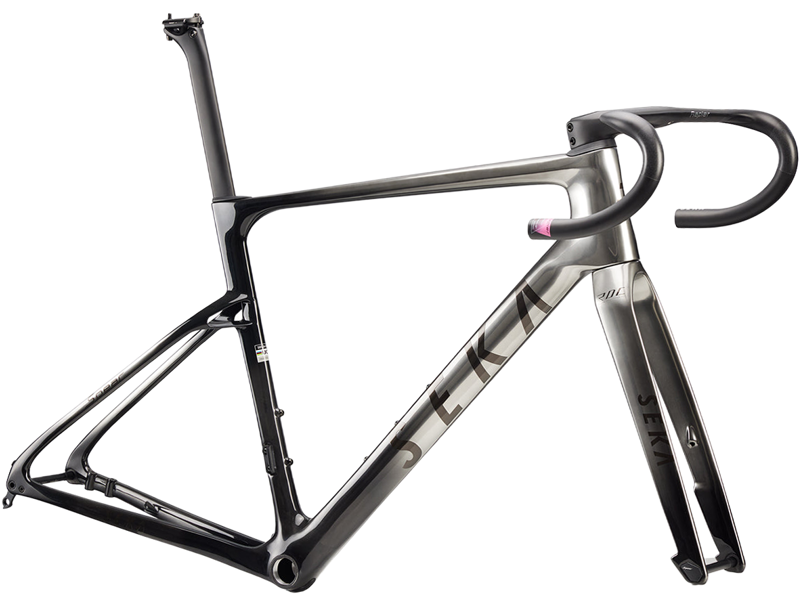
That is SEKA's claim for the Spear, and it is not made lightly. It is supported by 280,000-plus data points generated in the Silverstone Sports Engineering Hub — the same wind tunnel used by Formula One teams — in collaboration with AeroCoach, whose client list runs to WorldTour professional cycling squads. When Cyclingnews reviewed the Spear in June 2026, independent testing confirmed it delivered aerodynamic performance placed behind only three dedicated aero road bikes in the entire test field, despite being designed and positioned as a lightweight all-rounder. The Spear does not ask riders to choose between weight and aerodynamics. It has been engineered to make that compromise unnecessary.
The engineering philosophy that produced it is what SEKA call their Sectionalized Design concept: every tube, every junction, every structural zone of the frame is specified for its precise mechanical function rather than built to a generalised carbon schedule. Thirty-seven layup iterations separated the first prototype from the finished frameset. The result is a structure with the aerodynamic profile of a time-trial machine and the weight of a pure climber, wrapped in a geometry that Cyclingnews independently validated against the Specialized Tarmac SL8 for handling balance.
The Wind Eye: Aerodynamics and Compliance From a Single Structure
The most important innovation on the Spear — and the most visually distinctive — is the Wind Eye, SEKA's proprietary seatstay junction. Where a conventional frameset joins both seatstays to the seat tube at a single point, the Wind Eye opens two distinct apertures where the stays meet the carbon structure behind the seat tube. That bifurcation does two things simultaneously, and doing both at once is what makes it exceptional.
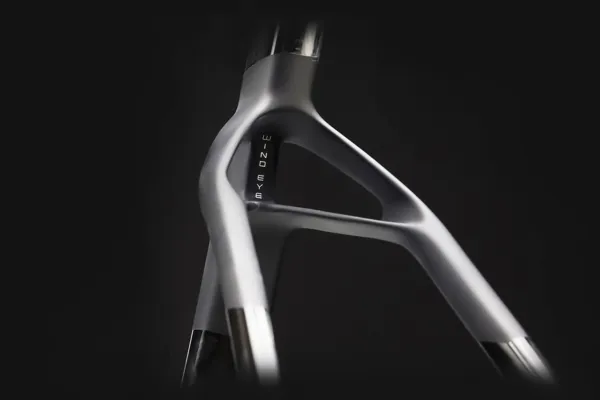
Aerodynamically, the rear triangle of any road bike is a chronic drag problem. The seat tube creates a wake, and the rear wheel forces turbulent air directly back into it, compounding the drag penalty with every increase in speed. The Wind Eye reshapes that zone entirely — stabilising airflow through the apertures and reducing the low-pressure turbulent pocket behind the seat tube. In isolation, the structure saves 2.66 watts at 40km/h, a meaningful contribution to the Spear's total 6-watt aerodynamic saving over the previous Exceed generation.
Structurally, the same apertures allow the rear end of the frame to flex vertically in a carefully calibrated non-linear manner, absorbing road surface energy before it reaches the rider. Vertical compliance is measured at 109 N/mm, a 23% improvement over the Exceed RDC, and seatpost deflection reaches 17mm under load. Lateral and torsional stiffness remain uncompromised — the Wind Eye is not a flexy rear end, it is a deliberately tuned one. SEKA validated the structure through 150,000 fatigue cycles at 144kg applied 85mm behind seatpost centre, which is three times the cycle count at a 20% higher load and 21% greater offset than the ISO standard requires. The Wind Eye's compliance is an engineered outcome, not a by-product of lightness.
Materials: Six Grades, One Purpose
The Spear's weight and stiffness figures are the direct result of a carbon selection process that starts with materials science rather than frame design. Six distinct fibre grades are used in a single frameset, each deployed only in the zones where its specific mechanical properties are needed.
The structural foundation is TeXtreme, a spread-tow fabric at just 20 grams per square metre that delivers outstanding impact resistance and fibre-to-resin uniformity. It costs approximately three times as much as standard T800 carbon and offers properties that nothing at a lower price point can match for this application. Layered alongside it are two pitch-based ultra-high modulus fibres from Mitsubishi Chemical: DIALEAD PITCH 65T and PITCH 80T. These are produced from coal tar pitch rather than the polyacrylonitrile precursor used in conventional aerospace carbon, which allows them to reach modulus values that PAN-based fibres cannot. The PITCH 65T achieves 2.1 times the modulus of Toray T1000; the PITCH 80T achieves 2.5 times the modulus of T1100 — Toray's current ceiling for PAN-based production carbon. Materials at this level are found in aerospace structures and high-end motorsport components, and their controlled deployment in a road bicycle frame is genuinely rare.
Completing the schedule are Mitsubishi 24T, 30T and 40T fibres in FAW69 format — 69 grams per square metre — which provide structural continuity and allow fine-grained stiffness tuning across transitional zones that the ultra-high modulus materials cannot address alone. The frame is produced using True-One-Piece Moulding, forming the structure from a single mould rather than bonding tube sections together. This eliminates the weight of bonded joints (25 grams versus equivalent bonded construction), removes potential failure points at every junction, and produces measurable improvements in fatigue strength, yield strength and fracture toughness. Finally, PMI (PolyMethyl MethAcrylate) foam filling is used in specific structural zones to increase buckling resistance in the thin-walled sections — a technique common in aerospace panel engineering and new to production road frames. It allows carbon walls to be thinner and lighter than would otherwise be structurally viable without compromising resistance to the compressive loads of hard riding.
The full schedule runs to 350 individual pieces of precisely cut and hand-placed carbon cloth, refined across 30-plus layup iterations before the final specification was locked.
Spear vs Spear RDC: The Same Frame, a Different Carbon Schedule
The Spear and the Spear RDC are built from the same mould, share the same geometry, the same Wind Eye structure, the same True-One-Piece Moulding, the same fork and seatpost, and ship with the same Rapier integrated handlebar. They are manufactured in the same facility under the same quality controls. The difference between them is entirely in what the carbon schedule is asked to do.
The Spear Standard uses a high-performance layup that delivers the full aerodynamic and structural package of the platform at a more accessible price — the 6-grade carbon architecture, the Wind Eye, the True-One-Piece construction, all present in a frameset that weighs 780g in size M unpainted. It is a race-capable bike from the outset, and for most riders building their first serious carbon racing machine it is the natural starting point.
The Spear RDC — Racing Day Combatant — represents what happens when that same architecture is pushed as far as current materials science will allow. The carbon schedule shifts to carry a higher proportion of DIALEAD pitch-based ultra-high modulus fibres and additional TeXtreme in the zones where stiffness-to-weight is most performance-critical, and the PMI foam placement is refined to its finest specification. The result is a frame weight of 685g in size M unpainted — 95 grams less than the Standard, achieved not by simplifying the frame but by intensifying the material. In Shadow Black paint, a measured M-size RDC frame weighs 729g ±35g. Stiffness testing shows the RDC is 5% stiffer than the Exceed RDC and achieves a 14.5% better stiffness-to-weight ratio. For riders targeting race day performance, that 95-gram difference is meaningful not just in absolute terms but in what it represents: the maximum the current frame design can achieve.
For comparison: the Pinarello Dogma F, built around a Toray T1100 1K carbon front triangle, has a claimed frame weight of approximately 690g in its most advanced configuration and retails as a complete bike at £12,000–£13,500. The Spear RDC comes in at 685g — lighter — while delivering superior wind-tunnel-measured aerodynamic performance and a geometry that rides comparably on the Tarmac SL8 scale. The Cannondale SuperSix EVO HiMod, built around a frame in the 750–800g range, retails with Dura-Ace Di2 at approximately £8,500–£9,500. The Spear RDC built to an equivalent specification competes on every headline metric at a substantially lower investment.
The Rapier Integrated Handlebar
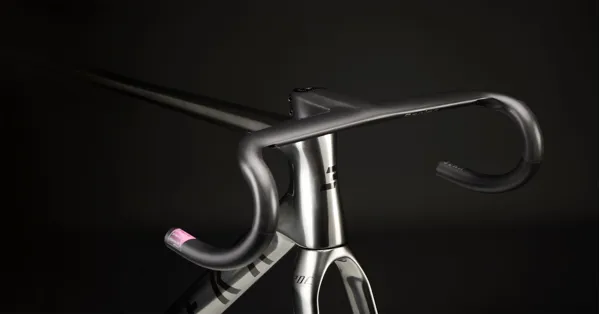
Every Spear frameset — Standard and RDC alike — ships with the Rapier integrated handlebar included. The Rapier is sold as a standalone component for $499 / approximately £415, which makes its inclusion significant, but the more important point is that it is a genuine performance component rather than a packaged-in extra. It was developed alongside the Spear in the same wind tunnel, manufactured using the same True-One-Piece Moulding process, and optimised as part of the complete front-end aerodynamic system rather than as an accessory fitted to it. At its thinnest cross-section the bar measures just 16mm, making it one of the narrowest-profile integrated handlebars in production. The lower drops feature a flared grip section for a more controlled hold in the sprinting and descending position.
Nineteen distinct size combinations are available — upper widths from 360mm to 415mm with stem lengths from 80mm to 130mm — which means riders across a wide range of body proportions can arrive at a correct fit without custom parts or spacer compromises. Computer, camera and light mounts are integrated into the bar. Titanium stem bolts are included. At 310 grams for the 375mm/100mm specification, the Rapier contributes almost nothing to the overall system weight while completing the aerodynamic and functional picture.
Geometry: 5+2 Non-Linear Sizing
The Spear's geometry was not derived from a template and then scaled across sizes. It was developed through iterative CFD analysis and rider testing, and the final specification has been independently validated to sit in a handling envelope close to the Specialized Tarmac SL8 — the current reference point for balanced race-bike geometry.
Stack and reach numbers across the five standard sizes offer purposeful, neutral geometry that suits both aggressive racing positions and longer-distance riding comfort, while the dedicated MR (medium race) and LR (large race) sizes extend the system for riders who want longer reach and lower stack without being forced into a smaller frame to achieve it. The race sizes sit between their standard counterparts in the geometry table, interspersed rather than appended, which is what SEKA mean by non-linear — the sizing system is designed to offer genuine choice across a broader range of rider proportions than five sizes alone could address.
Refer to the geometry chart below or in the product pages for full measurements across all seven sizes, including rider height guidance.
SEKA Spear & Spear RDC — Geometry
Both models share identical geometry. Race sizes (MR, LR) offer longer reach and lower stack for an aggressive fit.

| Measurement | XS | S | M | MR⬦ | L | LR⬦ | XL |
|---|
| Rider Height Guide (cm) | 150–163 | 161–173 | 170–180 | 171–186 | 177–187 | 179–194 | 185–198 |
| Stack (mm) | 508 | 524 | 543 | 538 | 570 | 560 | 600 |
| Reach (mm) | 362 | 370 | 379 | 386 | 389 | 397 | 402 |
| Stack-to-reach (STR) | 1.403 | 1.416 | 1.433 | 1.394 | 1.465 | 1.411 | 1.493 |
|---|
| Seat tube C–T (mm) | 449 | 463 | 480 | 476 | 508 | 496 | 535 |
| Head tube length (mm) | 107 | 120 | 136 | 130 | 164 | 153 | 193 |
| Head tube angle (°) | 70.6 | 71.7 | 72.9 | 73.0 | 73.0 | 73.1 | 73.5 |
| Seat tube angle (°) | 75.0 | 74.8 | 74.0 | 74.0 | 73.5 | 73.5 | 73.0 |
| Wheelbase (mm) | 969 | 973 | 973 | 978 | 990 | 995 | 1008 |
| Chainstay (mm) | 410 | 410 | 410 | 410 | 410 | 410 | 410 |
| Front center (mm) | 570 | 574 | 574 | 578 | 591 | 585 | 608 |
| Fork offset (mm) | 48 | 48 | 44 | 44 | 44 | 44 | 44 |
| BB drop (mm) | 74 | 74 | 72 | 72 | 72 | 72 | 72 |
| Trail (mm) | 68 | 62 | 58 | 58 | 58 | 57 | 55 |
| Fork axle-to-crown (mm) | 372 | 372 | 372 | 372 | 372 | 372 | 372 |
Standard sizes: XS / S / M / L / XL ⬦ Race geometry (MR, LR) — longer reach, lower stack vs. equivalent standard size
All measurements in mm unless otherwise noted.
Frame weights: Spear Standard 780g (M, unpainted); Spear RDC 685g (M, unpainted) / 729g ±35g (M, Shadow Black).
Fork A–C are constant across all sizes.
The Specialized Tarmac SL8 was chosen as the Spear's geometry reference point for a straightforward reason: it is the bike that the road cycling industry currently uses to define what balanced race-bike handling should feel like. When Specialized released the SL8, they resolved a tension that had existed in the segment for years — the trade-off between the aggressive, aerodynamically optimal position of a dedicated aero bike and the neutral, confidence-inspiring geometry of a pure climber — and the result was broadly accepted by the professional peloton and independent press as the standard against which all-round road frames should be measured.
SEKA understood that building a new frameset with superior aerodynamic data and lighter carbon construction would mean nothing if the geometry produced a bike that felt unfamiliar or demanding to ride, and so the Spear's stack, reach, and handling characteristics were developed through iterative CFD and rider testing specifically to arrive in the same handling envelope as the SL8. When Cyclingnews reviewed the Spear in June 2026, their independent assessment confirmed it — the Spear rides with the same balanced, responsive character that makes the SL8 the reference it is, while delivering wind-tunnel-measured aerodynamic performance that places it ahead of the SL8 in drag, and a 685g RDC frameset weight that sits below it. The SL8 in its top Dura-Ace Di2 specification retails at approximately £11,500. The Spear RDC built to an equivalent standard costs just £7500, handles identically, and goes faster.
£4k in your pocket and the edge on the road.
The Range at a Glance
The Spear collection at 7hundred covers the frameset in both Standard and RDC specifications, and complete build options. At the time of writing, the complete builds pair the 685g RDC frameset with Zipp 404 Firecrest carbon wheels across two groupset families — SRAM's wireless AXS ecosystem (Red E1 and Force E1) and Shimano's semi-wireless Di2 platform (Dura-Ace R9200 and Ultegra R8100) — allowing riders to choose their preferred control system and the performance level that suits their riding and their budget. Each complete build is a coherent, race-ready system rather than a collection of parts. We will be offering custom build options on the Spear Standard frame as well.
Frameset Specifications
| Specification | Detail |
|---|
| Bottom Bracket | BSA threaded, 68mm shell width |
| Headset Bearing | Upper & Lower: 49.5 × 40.5 × 6.5mm, 45/45° |
| Thru-Axle (Front) | L118.6mm, M12 × P1.0 |
| Thru-Axle (Rear) | L165.2mm, M12 × P1.5 |
| Maximum Tyre Width | 32mm |
| Seatpost Rail Compatibility | 7×7mm, 7×9mm, 7×10mm, 7×11mm |
| Wheel Size | 700c |
| Seatpost Offset Options | 0mm or 15mm setback |
| In the Box | Frame, fork, seatpost, Rapier integrated handlebar + accessories, aero bottle cage set |
Key Features & Benefits
| Feature | Benefit |
|---|
| Wind Eye structure | Saves 2.66W drag and delivers 23% more vertical compliance — faster and more comfortable simultaneously |
| 6W total aero saving vs Exceed | 15.27 seconds saved over 40km at 40km/h, validated at Silverstone SSEH |
| Spear RDC: 685g frame (M, unpainted) | 95g lighter than the Standard; matches or beats the Pinarello Dogma F on weight at a fraction of the price |
| 6-grade carbon construction (RDC) | DIALEAD pitch-based ultra-high modulus fibres and TeXtreme deliver the stiffness-to-weight of aerospace structures |
| True-One-Piece Moulding | Eliminates bonded joints — 25g lighter, measurably stronger in fatigue, yield and fracture toughness |
| PMI foam-filled sections | Aerospace-derived buckling resistance in thin-walled zones without meaningful weight addition |
| 5+2 Non-linear geometry | 5 standard sizes plus dedicated MR and LR race geometry — more riders, more positions, no compromise |
| Rapier integrated handlebar included | 19 size combinations across widths and stem lengths |
| BSA threaded bottom bracket | Universal servicing compatibility; no press-fit complications |
| 32mm maximum tyre clearance | Racing to training conditions covered on a single frameset |
Frame weights stated for unpainted bare frames unless noted. RDC = Racing Day Combatant. Wind tunnel data obtained at Silverstone Sports Engineering Hub in collaboration with AeroCoach. Aerodynamic comparison to Exceed RDC at 40km/h relative wind speed. Geometry independently validated as comparable to Specialized Tarmac SL8. Cyclingnews review: June 2026.