Built for the roads we actually have
Pinarello open the X Series white paper with a claim that would sound like marketing if the frame underneath it did not back the claim up: that the reactivity and speed the brand has spent forty years being known for can coexist with comfort and long-range efficiency, without either quality being diluted to accommodate the other. The bikes were designed around roads as they are, rather than as they appear on the televised routes of Grand Tours where the hosting prinicipality has spent its annual maintenance budget on re-laying mountain passes with fresh dlack-top. In practice - patched tarmac, unmarked gravel links between lanes, and surfaces that deteriorate halfway down a descent a rider has already committed to.
What makes the argument more interesting than the usual appeal to comfort is where Pinarello point it. Their concern is fatigue, and specifically the compounding kind, because a rider who has absorbed four hours of vibration through the bars and the saddle is measurably slower than one who has not, and the deficit shows up as sub-optimal lines and compromised decision making, well before it shows up in the legs. Everything on the X series frame, from the architecture of the seatstays to the width of rubber it will swallow, exists to postpone that moment.
Two riders are described in the paper, and they sit at opposite ends of experience. The first is someone relatively new to road cycling, for whom handling that stays predictable in the wet and on a bad surface is the difference between confidence and a slow retreat from the sport. The second has been riding long enough to have worked out that real speed over a long day comes from efficiency and freshness rather than from a low position held grimly for as long as it can be tolerated.
The position, and why it holds up
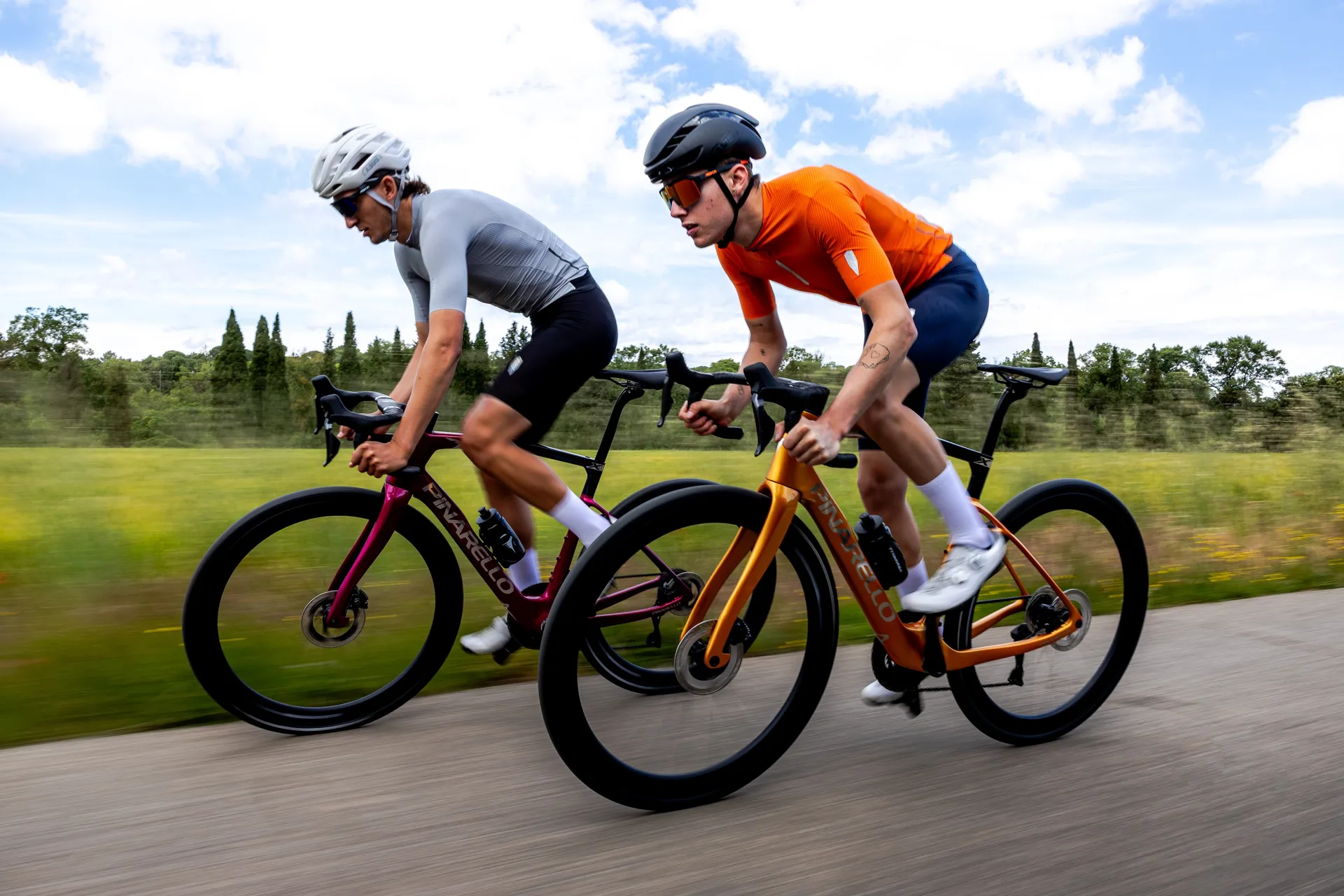
Reach is shorter than it would be on a race frame and stack is correspondingly taller, so a rider sits with the chest open and with noticeably less weight travelling down through the hands and wrists into the bars, which is the difference between a position that feels efficient at hour one and one that still feels that way at hour five.
Nine sizes run from a 42cm to a 59cm measured from the centre of the bottom bracket to the end of the seat tube, and the consistency Pinarello have built across that spread deserves attention, because extending a size range this far usually costs handling coherence somewhere. Every frame in the range carries a 415mm chainstay and a 384mm fork, so the back of the bike behaves identically whichever size a rider ends up on; fork rake steps from 52mm on the three smallest frames to 47mm on the six above them, compensating for the steepening head angle that runs from 70 degrees at the bottom of the range to 72.5 at the top; and bottom bracket drop holds at 72mm until the two largest sizes, where it eases to 67mm to keep the proportions sensible on a very long frame. A 42cm and a 59cm handle with recognisably the same manners, which is not something that can be said of every nine-size range.
Two components solving the same problem
The vibration control comes from a duo of elements that Pinarello designed together and describe as a single system, which is worth understanding before either is judged on its own.
New X-Stays 2.0 is the second generation of the double-arm seatstay architecture, and the changes are a lower attachment point to the frame and a refinement of the geometry around it. Where a conventional pair of stays offers two routes for road vibration to reach the rider, this arrangement offers four connection points across which that energy is dispersed, and the lower linkage exists to damp the rebound that follows an impact, so the back of the bike settles after a pothole rather than continuing to argue about it for the next few metres.
The Adaptive seatpost was drawn specifically for this project, its tube section and overall shape worked out to balance stiffness against absorption while keeping the profile aerodynamically sensible. Pinarello's reasoning for it is practical: a rider who stays planted on the saddle over broken ground can keep applying power consistently, whereas a rider being bounced out of the saddle loses a fraction of every pedal stroke to simply staying aboard. Between them the two parts filter the high-frequency vibration that causes fatigue and take the edge off the larger impacts, and they do it without surrendering the lateral stiffness that makes a frame feel like it is going somewhere when a rider stands up.
A narrower front end, and the cockpit that suits it
Pinarello have routed hoses and cables entirely inside the bar, stem and frame for years under the name TiCR, short for Total Internal Cable Routing, and the approach has always carried a structural cost at the front of the bike. Because the lines run down either side of the steerer tube, the head tube has to be wide enough to clear both the housing and a uniform pair of bearings, which means a routing system chosen for tidiness ends up determining the shape of the bike's leading edge.
e-TiCR resolves that, and the e stands for elliptical. The steerer tube is ovalised rather than round; the cables move from the sides of the steerer to sit directly in front of it, which is the change that allows the head tube to narrow; and the headset runs differential bearings, larger at the bottom than the top, so bearing size remains where steering loads are highest and comes out of the equation where they are not. The front of the bike gets slimmer without the steering losing anything.
The cockpits were built for that head tube rather than adapted to it. Two of the four bikes use the Claw bar and stem, the same two-piece cockpit Pinarello fit to the current F Series, which keeps the routing fully internal while leaving stem length and bar width independently adjustable. The X1 retains the previous generation's Frameset and therefore the TiCR system while the X7 runs the MOST Talon Ultra Fast one-piece carbon cockpit instead - the same front-end architecture employed on the Dogma line.
Clearance for versatility
The X-series features a maximum tyre clearance of 40mm (35mm on the X1), which is a great deal of room on a road frame and changes what a modern tubeless setup can do for a rider. Running 32s or 35s at a pressure that suits the surface rather than the rule book gives grip, absorption and cornering security that a 28 cannot approach, and it moves the first line of defence against a bad road out to the contact patch, where it costs nothing.
It changes where the bike can go, too. A gravel link between two lanes, or a farm track that shortens a ride by six miles, stops being a reason to turn around and becomes part of the route. Tyres no longer curtail exploration.
Storage that keeps the pockets free
Inside the down tube sits a sealed compartment, accessed through a lockable port, with a toolbag shaped to slide straight into it that features specific compartments for a CO2 cartridge, tyre levers, a TPU inner tube, a Most mini pump and a chuck. Everything that would otherwise be distributed between three jersey pockets and a saddlebag travels inside the frame, out of the wind and off the rider's back.
Future proof...
The Pinarello Design Dropout accepts both SRAM's UDH standard and Shimano's current and future designs, which means a groupset change in three years is a component decision rather than a frame decision, and a replacement hanger is the common part every good shop stocks rather than something ordered in.
The range
There are four bikes in the UK, built on one frame shape and separated by carbon grade and specification. They share specification parity with the F-Series, so side by side decisions can be made on fit and purpose, rather than desire!
The X7 sits at the top in T900UD, the grade Pinarello describe as their balance of reactivity, damping and low weight, and it arrives with Shimano Ultegra Di2, Most UF45 carbon wheels and the MOST Talon Ultra Fast one-piece cockpit. Below it, the X5 and X3 share T700UD carbon and Shimano 105 Di2, and what actually separates them is the wheelset: Most UF45 carbon rims on the X5, aluminium DT Swiss A1800s on the X3, which places the difference in the component a rider is most likely to change anyway. The X1 remains the gateway to the brand - all the Pinarello feel and heritage but at a more accessible price. The X1 is built in T600UD on the previous generation's mould (X-Stays 1.0) for maximum damping while retaining those character traits that define the brand, with mechanical Shimano 105 and aluminium Shimano wheels, and it carries the previous Most Tiger TiCR cockpit. The frame shape, geometry, tyre clearance and the storage are identical across X3 / X5 and X7.